
Mazzaltov World News provides you with the latest live coverage of Current Affairs, Sports, Health, Weather, Entertainment, Business and Travel News from around the world.
Here’s where things stand on Friday 4 July 2025:
- The deputy head of the Russian navy, Mikhail Gudkov, has been killed in Russia’s Kursk region, the country’s Ministry of Defence has confirmed. He is one of the most senior Russian commanders to have been killed since Russia launched its full-scale invasion of Ukraine more than three years ago.
- Russian President Vladimir Putin has told his United States counterpart, Donald Trump, that Moscow will not give up on its goal of eliminating the “root causes” of the war in Ukraine.
- Kyiv hit by barrage of drone strikes as Putin rejects Trump’s truce bid.The strikes came hours after a call between US President Donald Trump and Russian President Vladimir Putin, after which Trump said he was “disappointed” that Putin was not ready to end the war against Ukraine.
- Russia’s overnight air strikes broke another record, Ukraine’s air force said, with 72 of the 550 dronespenetrating air defences – up from a previous record of 537 launched last Saturday night.
- Kyiv has warned that an interruption of US weapons shipments will encourage Russia to prolong the war in Ukraine, now in its fourth year.
- On Tuesday the White House said it had cut off some weapons deliveries to Ukraine. The decision was taken “to put America’s interests first” following a defence department review of US “military support and assistance to other countries”,
Russian President Vladimir Putin has told his United States counterpart, Donald Trump, that Moscow will not give up on its goal of eliminating the “root causes” of the war in Ukraine.
“Russia will not back down,” Kremlin aide Yuri Ushakov told reporters although he added that Putin had also expressed a “readiness” to “seek a political and negotiated solution to the conflict” during his one-hour phone conversation with Trump on Thursday.
The phrase “root causes” is shorthand for the Kremlin’s argument that it was compelled to launch a full-scale invasion of Ukraine in 2022 to prevent the country from joining NATO and being used by the Western alliance as a launchpad to attack Russia – arguments rejected by Kyiv and its allies but supported in part by Trump.
Trump said after the call that he had made “no progress” with Putin on moving towards a ceasefire, adding that he was “not happy” about the war in Ukraine.
The phone call, their sixth since Trump started his second term in January, came the day after the Pentagon confirmed it was halting some weapons deliveries to Kyiv, including air defence missiles and precision-guided artillery. They were promised under President Joe Biden’s administration. The announcement was made as Russia has intensified its attacks on Ukraine
Trump and Putin did not broach the subject of the paused weapons deliveries, according to the Kremlin aide, who said the US president had raised the issue of bringing about a swift end to the war.
While the prospect of a face-to-face meeting was not discussed, the two leaders agreed to keep talking.
Although Trump has tried to mediate in the Ukraine war, he has little progress to show for it. Putin has thus far rejected Washington’s proposal for an unconditional ceasefire, and there was nothing in the Kremlin readout to suggest any shift in his position. Ukraine supported the proposal.
Ushakov said that while Russia was open to continuing to speak with the US, any peace negotiations needed to occur between Moscow and Kyiv.
He made the comment amid some indications that Moscow is trying to avoid a trilateral format for any peace negotiations. Ukrainian officials have said Russian negotiators asked US diplomats to leave the room during a meeting in Istanbul in early June.
Putin and Trump last talked in mid-June when Putin offered to mediate in the recent 12-day Iran-Israel war. Trump responded to Putin’s offer by switching the focus back to Ukraine, saying: “No, I don’t need help with Iran. I need help with you.”
Ushakov said that during Thursday’s call, Putin emphasised the need to resolve all “disputes, disagreements and conflict situations” regarding Iran through diplomatic means.
The US waded into the Israel-Iran conflict last month, bombing three of Iran’s nuclear sites, a move condemned by Moscow as unprovoked and illegal.
Earlier on Thursday, Ukrainian President Volodymyr Zelenskyy met European Union leaders in Denmark, saying doubts over US military aid to Ukraine reinforced the need to “strengthen our cooperation and coordination through the EU, NATO and also in our direct relations”.
Trump has in effect nixed Ukraine’s attempts to join the NATO military alliance.
Zelenskyy told reporters he hopes to speak to Trump as soon as Friday about the pause in weapons shipments.
Kyiv hit by barrage of drone strikes as Putin rejects Trump’s truce bid
Kyiv hit by barrage of drone strikes as Putin rejects Trump’s truce bid
A pall of acrid smoke hung over Kyiv on Friday morning following a night of intensive Russian strikes that hit almost every district of the Ukrainian capital, injuring 23 people, officials say.
The hours of darkness were punctuated by the staccato of air defence guns, buzz of drones and large explosions. Ukraine said Russia fired a record 550 drones and 11 missiles.
The strikes came hours after a call between US President Donald Trump and Russian President Vladimir Putin, after which Trump said he was “disappointed” that Putin was not ready to end the war against Ukraine.
Moscow says war will continue for as long as it is necessary to reach its objectives.
Russia’s overnight air strikes broke another record, Ukraine’s air force said, with 72 of the 550 dronespenetrating air defences – up from a previous record of 537 launched last Saturday night.
Air raid alerts sounded for more than eight hours asseveral waves of attacks struck Kyiv, the “main target of the strikes”, the air force said on the messaging app Telegram.
Ukrainian President Volodymyr Zelensky condemned one of the most “demonstratively significant and cynical” attacks of the war, describing a “harsh, sleepless night”.
Noting that it came directly after Putin’s call with Trump, Zelensky added in a post on Telegram: “Russia once again demonstrates that it does not intend to end the war”.
He called on international allies – particularly the US – to increase pressure on Moscow and impose greater sanctions.
Footage shared on social media by Ukraine’s state emergency service showed firefighters battling to extinguish fires in Kyiv after Russia’s large-scale overnight attack.
According to Ukrainian authorities, railway infrastructure was damaged and schools, buildings and cars set ablaze across the capital.
Poland’s Foreign Minister, Radosław Sikorski, said the Polish consulate had also been damaged.
The Russian strikes also hit the regions of Sumy, Kharkiv, Dnipropetrovsk and Chernihiv.
Russia’s defence ministry said the “massive strike” had been launched in response to the “terrorist acts of the Kyiv regime”.
The acting governor of Russia’s southern Rostov region said a woman was killed in a Ukrainian drone strike on a village not far from the border on Friday night.
Friday’s attacks were the latest in a string of major Russian air strikes on Ukraine that have intensified in recent weeks as ceasefire talks have largely stalled.
War in Ukraine has been raging for more than three years since Russia launched its full-scale invasion in February 2022.
Following his conversation with Putin on Thursday, Trump said that “no progress” to end the fighting had been made.
“I’m very disappointed with the conversation I had today with President Putin, because I don’t think he’s there, and I’m very disappointed,” Trump said.
“I’m just saying I don’t think he’s looking to stop, and that’s too bad.”
The Kremlin reiterated that it would continue to seek to remove “the root causes of the war in Ukraine”. Putin has sought to return Ukraine to Russia’s sphere of influence and said last week that “the whole of Ukraine is ours”.
Responding to Trump’s comments on Friday, Putin’s spokesman Dmitry Peskov told the BBC that as long as it was not possible to secure Russia’s aims through political-diplomatic means, “we are continuing our Special Military Operation” – Russia’s preferred name for the invasion.
Meanwhile, President Zelensky said that he hoped to speak to Trump about the supply of US weapons after a decision in Washington to halt some shipments of critical weapons to Ukraine, including those used for air defences.
Kyiv has warned that the move would impede its ability to defend Ukraine against escalating airstrikes and Russian advances on the frontlines.
Speaking to reporters, Trump said “we’re giving weapons” and “we haven’t” completely paused the flow of weapons. He blamed former President Joe Biden for “emptying out our whole country giving them weapons, and we have to make sure that we have enough for ourselves”.
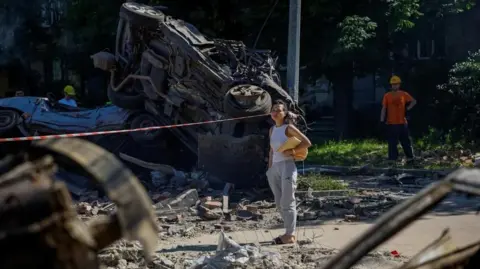
Deputy Russian Navy chief killed in strike near Ukraine border
The deputy head of the Russian Navy has been killed near the Ukrainian border, the Russian military has confirmed.
Major General Mikhail Gudkov, appointed by President Vladimir Putin to the senior naval post in March, was killed during what Russia’s defence ministry described as “combat work” in the western Kursk region, which borders Ukraine’s Sumy region. The ministry gave no further details about the operation.
Last summer Ukraine launched a surprise offensive in Kursk. While its troops have mostly been driven out, in June Kyiv said it was still holding onto small areas of the region.
Gudkov’s death is one of the most high-profile losses for Moscow since the start of its full-scale invasion of Ukraine.
According to Oleg Kozhemyako, governor of the Primorsky region in Russia’s Far East, ten others were also killed in the incident.
Kozhemyako made the announcement on Telegram, where he described Gudkov as a loyal officer who died “carrying out his duty”.
Unconfirmed reports from Russian and Ukrainian military-linked Telegram channels suggest the deaths were the result of a Ukrainian missile strike on a Russian command post near the town of Korenevo, around 30km (19 miles) from the border.
Ukraine has not officially commented on the attack – consistent with its usual policy of not confirming targeted strikes on Russian territory.
Gudkov had previously commanded the 155th Naval Infantry Brigade of the Pacific Fleet, a unit involved in heavy fighting across eastern Ukraine and later in the Kursk region itself.
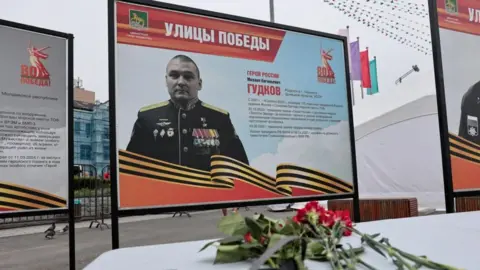
Footage from the far eastern city of Vladivostok, home to Russia’s Pacific Fleet, showed mourners laying flowers at a makeshift memorial to Gudkov, who received the Gold Star medal of Hero of Russia in late 2023. He was seen receiving the honour from President Putin at a Kremlin ceremony in February.
Ukraine has not acknowledged involvement in Gudkov’s death.
However sources within Ukrainian security services have previously told the media, including the BBC, that they were behind similar targeted strikes, such as the killing of Gen Igor Kirillov in December 2024.
Earlier this year, General Yaroslav Moskalik was killed in a car bomb attack in Moscow – an incident the Kremlin also blamed on Kyiv. At the time Presidential spokesman Dmitry Peskov accused Ukraine of “continuing its involvement in terrorist activities inside our country”.
Since the start of Russia’s full-scale invasion of Ukraine in 2022, there have been several high-level assassination plots on both sides.
Last year the Ukrainian security service (SBU) said it foiled a Russian plot to assassinate President Volodymyr Zelensky and other high-ranking Ukrainian officials.
At the start of the war, the Ukrainian leader said he was Russia’s “number one target”.
Meanwhile, officials in the southern Ukrainian city of Odesa said two people were killed and six injured in a missile strike on the port on Thursday.
Earlier, strikes on the central city of Poltava targeting an army recruitment centre killed two people and wounded nearly 50 others, authorities said.
Ukraine fears increased Russian aggression after US halt of weapons supply
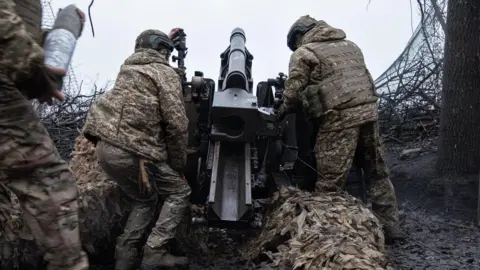
Kyiv has warned that an interruption of US weapons shipments will encourage Russia to prolong the war in Ukraine, now in its fourth year.
On Tuesday the White House said it had cut off some weapons deliveries to Ukraine.
The decision was taken “to put America’s interests first” following a defence department review of US “military support and assistance to other countries”, White House spokesperson Anna Kelly said.
Ukrainian President Volodymyr Zelensky said the two countries were now “clarifying all the details on supplies”, while the foreign ministry warned any delays “would only encourage the aggressor to continue war and terror, rather than seek peace”.
The ministry particularly emphasised the need for Kyiv to strengthen its air defences – as Russia continues to pummel the country with missiles and drones on a near-nightly basis.
A Kyiv-based US diplomat was invited to the foreign ministry for talks on Wednesday.
However, Ukraine’s defence ministry said it had not received any official notification from the US about the “suspension or revision” of the weapons deliveries, and urged people not to speculate on the basis of partial information.
But in a statement the defence ministry also said the path to ending the war was “through consistent and joint pressure on the aggressor”.
At the weekend Ukraine endured its biggest aerial attack since the start of Russia’s full-scale invasion, with more than 500 drones and ballistic and cruise missiles launched at its cities.
US officials did not immediately say which shipments were being halted.
According to American broadcaster NBC, the weapons being delayed could include Patriot interceptors, Howitzer munitions, missiles and grenade launchers.
The US has sent tens of billions of dollars in military aid to Ukraine since Russia launched its full-scale invasion in February 2022, leading some in the Trump administration to voice concerns that US stockpiles are too low.
The Kremlin, for its part, welcomed news of the reduction in weapons shipments, saying reducing the flow of weapons to Kyiv will help end the conflict faster.
“The fewer the number of weapons that are delivered to Ukraine, the closer the end of the special military operation,” Kremlin spokesman Dmitry Peskov told reporters.
Fedir Venislavskyi, an MP for Ukraine’s ruling party, said the decision was “painful, and against the background of the terrorist attacks which Russia commits against Ukraine… it’s a very unpleasant situation”.
A Ukrainian military source quoted by the AFP news agency said Kyiv was “seriously dependent on American arms supplies, although Europe is doing its best, but it will be difficult for us without American ammunition”.
Ukraine’s European allies have spent billions in military aid over the last three-and-a-half years.
However, military support for Kyiv is not endorsed by everyone on the political spectrum.
Czech President and former top Nato official, Petr Pavel, has been a staunch supporter of Ukraine – but he told BBC Russian he could “not guarantee” continued ammunition support for Kyiv, as that was dependent on the result of forthcoming Czech elections.
“I don’t know what will be the priorities of a new government,” he said.
The Pentagon’s move is based on concerns that US military stockpiles are falling too low, a source told CBS News, although Anna Kelly stressed “the strength of the United States Armed Forces remains unquestioned – just ask Iran”.
Separately, the US Undersecretary of Defense for Policy, Elbridge Colby, said in a statement the Pentagon “continues to provide the President with robust options to continue military aid to Ukraine”.
However, he added “the department is rigorously examining and adapting its approach to achieving this objective while also preserving US forces’ readiness for Administration defence priorities”.
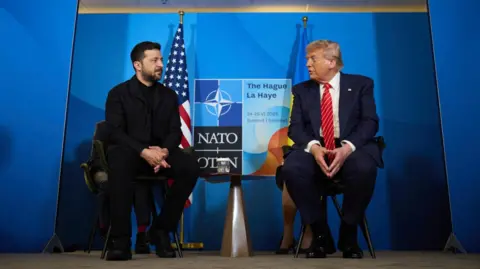
The pause comes less than a week after President Donald Trump discussed air defences with Volodymyr Zelensky at the Nato summit in the Netherlands.
Trump said US officials “are going to see if we can make some of them available” when asked by the BBC about providing extra Patriot anti-missile systems to Ukraine.
Referring to his conversation with Zelensky, Trump said: “We had a little rough times sometimes, but he couldn’t have been nicer.”
The two had a heated confrontation in the Oval Office in February. Afterwards, Trump said he was pausing military aid to Ukraine that had been earmarked by the previous Biden administration. Intelligence sharing with Ukraine was also suspended.
But both pauses were subsequently lifted.
In late April, the US and Ukraine signed a deal that would give the US access to Ukraine’s mineral reserves in exchange for military assistance.
Meanwhile, French President Emmanuel Macron spoke with his Russian counterpart Vladimir Putin on Tuesday – the first time in over two-and-a-half years.
They spoke on the phone for more than two hours, Macron’s office said, adding the French president had urged a ceasefire in Ukraine and for talks to start on a “solid and lasting settlement of the conflict”.
The Kremlin said Putin had “reminded Macron” that the West’s policy was to blame for the war, because it had “for many years ignored Russia’s security interests”.
Last month, Russia’s long-time leader told a forum in St Petersburg that he saw Russians and Ukrainians as one people and “in that sense the whole of Ukraine is ours”.
Moscow currently controls about 20% of Ukrainian territory, including the Crimea peninsula annexed in 2014.
Despite heavy losses, Russia has made slow, grinding advances in Ukraine in recent months and announced full control of the eastern Luhansk region this week – this has not been independently verified.
Moscow also says it has seized territory in the south-eastern region of Dnipropetrovsk – a claim denied by the Ukrainian military.
Meanwhile, on Tuesday a Ukrainian attack killed three people at a Russian arms production factory making drones and radars in Izhevsk, more than 1,000km (620 miles) from the border with Ukraine.