
Mazzaltov World News provides you with the latest live coverage of Current Affairs, Sports, Health, Weather, Entertainment, Business and Travel News from around the world.
Here’s where things stand on Sunday 14 July 2025:
Fighting
- Ukrainian officials said Russian air attacks overnight on Saturday killed at least two people in the western city of Chernivtsi and wounded 38 others across Ukraine.
- The raids also damaged civilian infrastructure from Kharkiv and Sumy in the northeast to Lviv, Lutsk and Chernivtsi in the west.
- The Russian Ministry of Defence said it attacked companies in Ukraine’s military-industrial complex in Lviv, Kharkiv and Lutsk, as well as a military aerodrome.
- The United Nations Human Rights monitoring mission in Ukraine said that June saw the highest monthly civilian casualties in three years, with 232 people killed and 1,343 injured.
- In Russia, a man was killed in the Belgorod region after a shell struck a private house, according to Governor Vyacheslav Gladkov.
Politics and diplomacy
- North Korean leader Kim Jong Un told visiting Russian Minister of Foreign Affairs Sergey Lavrov that his country was ready to “unconditionally support” all actions taken by Moscow in Ukraine.
- Earlier, Lavrov held talks with his North Korean counterpart, Choe Son Hui, in Wonsan, and they issued a joint statement pledging support to safeguard the national sovereignty and territorial integrity of each other’s countries, according to North Korean state media.
- Lavrov also warned the United States, South Korea and Japan against forming “alliances directed against anyone, including North Korea and, of course, Russia”.
- Slovakia’s prime minister, Robert Fico, said his government hoped to reach an agreement with the European Union and its partners on guarantees that Slovakia would not suffer from the end of Russian gas supplies by Tuesday. Slovakia has been blocking the EU’s 18th sanctions package on Russia over its disagreement with a proposal to end all imports of Russian gas from 2028. Slovakia, which gets the majority of its gas from Russian supplier Gazprom under a long-term deal valid until 2034, argues the move could cause shortages, a rise in prices and transit fees, and lead to damage claims.
- Russia blamed Western sanctions for the collapse of its agreement with the UN to facilitate exports of Russian food and fertilisers. The three-year agreement was signed in 2022 in a bid to rein in global food prices.
Weapons
- Ukrainian President Volodymyr Zelenskyy said Kyiv was “close to reaching a multilevel agreement” with the US “on new Patriot systems and missiles for them”. Ukraine was stepping up production of its own interceptor systems, he added.
Russia’s Lavrov meets Kim Jong Un in North Korea with Ukraine war at fore
North Korean officials have “reaffirmed their support for all objectives” in the Russia-Ukraine war, says Russian FM.

Russian Foreign Minister Sergey Lavrov has met with Kim Jong Un in North Korea, during which Pyongyang reaffirmed its support for Russia’s war in Ukraine in which thousands of its soldiers have been killed.
Lavrov “was received” by Kim, Russia’s Ministry of Foreign Affairs said on Telegram on Saturday, posting a video of the two men shaking hands and embracing in Wonsan. Russian and North Korean state media had announced the visit earlier, saying Lavrov would stay until Sunday.
It is the latest in a series of high-profile trips by top Moscow officials to North Korea as the countries deepen military and political ties with a focus on Russia’s offensive in Ukraine.
Pyongyang has become one of Moscow’s main allies during its more than three-year-long war in Ukraine, sending thousands of troops and conventional weapons to help the Kremlin remove Ukrainian forces from Kursk in Russia.
More than 6,000 North Korean soldiers have died in the Russia-Ukraine war, according to British Defence Intelligence.
North Korea has also agreed to dispatch 6,000 military engineers and builders to help reconstruction efforts there.
The South Korean intelligence service has said North Korea may be preparing to deploy additional troops in July or August.
The United States and South Korea have expressed concern that, in return, Kim may seek Russian technology transfers that could enhance the threat posed by his nuclear-armed military.
Earlier on Saturday, Lavrov met with his North Korean counterpart Choe Son Hui in Wonsan, a city on the country’s east coast, where a huge resort was opened earlier this month.
“We exchanged views on the situation surrounding the Ukrainian crisis … Our Korean friends confirmed their firm support for all the objectives of the special military operation, as well as for the actions of the Russian leadership and armed forces,” Russian news agency TASS quoted Lavrov as saying.
He also thanked the “heroic” North Korean soldiers, the Russian Foreign Ministry said.
In April, the two countries officially confirmed the deployment of North Korean troops to Russia for the first time, saying these troops had helped Russia to recapture the Kursk region – a claim contested by Ukraine.
Since then, Kim has been shown in state media paying tribute in front of flag-draped coffins of North Korean soldiers.
Russia’s Security Council Secretary Sergei Shoigu has visited Pyongyang multiple times this year.
The two heavily sanctioned nations signed a sweeping military deal last November, including a mutual defence clause, during a rare visit by Russian President Vladimir Putin to North Korea. Pyongyang has reportedly been directly arming Moscow to support its war in Ukraine.
In the meantime, Ukrainian President Volodymyr Zelenskyy said in his nightly address on Friday that US weapons shipments to his country had resumed, following the Pentagon’s decision to briefly halt the delivery of certain weapons to Kyiv over fears that US stockpiles were dwindling.
The US will deliver military supplies and send its envoy Keith Kellogg to Kyiv early next week, said Zelenskyy.
Russia’s agents killed after intelligence officer shot dead, says Ukraine
Ukraine said two agents working for Russia have been killed after a senior Ukrainian intelligence officer was shot dead on Thursday.
The head of Ukraine’s Security Service (SBU), Vasyl Malyuk, said in a video statement that two agents working for Russia’s security service FSB had been tracked down and “liquidated” after they resisted arrest on Sunday morning.
It comes after Col Ivan Voronych was shot several times in a Kyiv car park in broad daylight, after being approached by an unidentified assailant who fled the scene.
On Sunday, Ukraine’s national police said the two agents killed were “citizens of a foreign country”, without giving any further details. Moscow had no immediate response.
CCTV footage of the incident on 10 July – verified by the news agency Reuters – showed a man leaving a building in Kyiv’s southern Holosiivskyi district shortly after 09:00 local time (06:00 GMT), while another man ran towards him.
The SBU said on Sunday the suspects had been tracking Col Voronych’s movements prior to the attack, and were sent the co-ordinates of a hiding place where they found a pistol with a silencer.
It said that after he was shot, they then tried to “lay low,” but were found following a joint investigation with national police.
The SBU mainly focuses on internal security and counter-intelligence, like the UK’s MI5. But it has played a prominent role in sabotage attacks and assassinations deep inside Russia since Moscow’s full-scale invasion of Ukraine in 2022.
Sources within Ukraine’s security services told the BBC that the SBU was responsible for the killing of the high-ranking Russian Gen Igor Kirillov in December 2024.
In April, Gen Yaroslav Moskalik was killed in a car bomb attack in Moscow – which the Kremlin blamed on Kyiv.
Ukraine’s security services have never officially admitted responsibility for the deaths.
This week’s deaths come after Russian strikes on Ukraine have hit record levels.
On Tuesday, President Volodymyr Zelensky said Ukraine had faced its largest ever Russian aerial attack. In June, Ukraine recorded the highest monthly civilian casualties in three years, according to the UN.
Fighting has also continued on the frontlines, with Russia’s military making slow gains in eastern Ukraine and retaking control of most of Russia’s Kursk region that Kyiv’s forces seized in a surprise offensive last summer.
Efforts to negotiate a ceasefire in the more than three-year-long war have faltered.
Russia’s intensifying drone war is spreading fear and eroding Ukrainian morale
Everyone agrees: it’s getting worse.
The people of Kyiv have, like the citizens of other Ukrainian cities, been through a lot.
After three and a half years of fluctuating fortunes, they are tough and extremely resilient.
But in recent months, they have been experiencing something new: vast, coordinated waves of attacks from the air, involving hundreds of drones and missiles, often concentrated on a single city.
Last night, it was Kyiv. And the week before too. In between, it was Lutsk in the far west.
Three years ago, Iranian-supplied Shahed drones were a relative novelty. I remember hearing my first, buzzing a lazy arc across the night sky above the southern city of Zaporizhzhia in October 2022.
But now everyone is familiar with the sound, and its most fearsome recent iteration: a dive-bombing wail some have compared to the German World War Two Stuka aircraft.
The sound of swarms of approaching drones have sent hardened civilians back to bomb shelters, the metro and underground car parks for the first time since the early days of the war.
“The house shook like it was made of paper,” Katya, a Kyiv resident, told me after last night’s heavy bombardment.
“We spent the entire night sitting in the bathroom.”
“I went to the parking for the first time,” another resident, Svitlana, told me.
“The building shook and I could see fires across the river.”
The attacks don’t always claim lives, but they are spreading fear and eroding morale.
After an attack on a residential block in Kyiv last week, a shocked grandmother, Mariia, told me that her 11-year old grandson had turned to her, in the shelter, and said he understood the meaning of death for the first time.
He has every reason to be fearful. The UN’s Human Rights Monitoring Mission in Ukraine (HRMMU) says June saw the highest monthly civilian casualties in three years, with 232 people killed and over 1,300 injured.
Many will have been killed or wounded in communities close to the front lines, but others have been killed in cities far from the fighting.
“The surge in long-range missile and drone strikes across the country has brought even more death and destruction to civilians far away from the frontline,” says Danielle Bell, head of HRMMU.
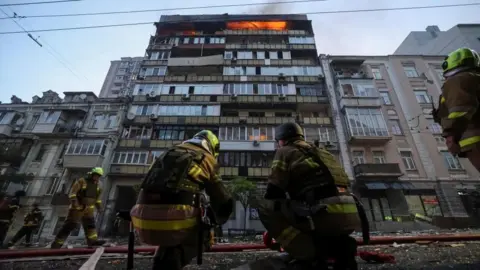
Modifications in the Shahed’s design have allowed it to fly much higher than before and descend on its target from a greater altitude.
Its range has also increased, to around 2,500km, and it’s capable of carrying a more deadly payload (up from around 50kg of explosive to 90kg).
Tracking maps produced by local experts show swirling masses of Shahed drones, sometimes taking circuitous routes across Ukraine before homing in on their targets.
Many – often as many as half – are decoys, designed to confuse and overwhelm Ukraine’s air defences.
Other, straight lines show the paths of ballistic or cruise missiles: much fewer in number but the weapons Russia relies on to do the most damage.
Analysis by the Washington-based Institute for the Study of War shows an increase in Russia’s drone and missile strikes in the two months following Donald Trump’s inauguration in January.
March saw a slight decline, with occasional spikes, until May, when the numbers suddenly rose dramatically.
New records have been set with alarming regularity.
June saw a new monthly high of 5,429 drones, July has seen more than 2,000 in just the first nine days.
With production in Russia ramping up, some reports suggest Moscow may soon be able to fire over 1,000 missiles and drones in a single night.
Experts in Kyiv warn that the country is in danger of being overwhelmed.
“If Ukraine doesn’t find a solution for how to deal with these drones, we will face great problems during 2025,” says former intelligence officer Ivan Stupak.
“Some of these drones are trying to reach military objects – we have to understand it – but the rest, they are destroying apartments, falling into office buildings and causing lots of damage to citizens.”
For all their increasing capability, the drones are not an especially sophisticated weapon. But they do represent yet another example of the vast gulf in resources between Russia and Ukraine.
It also neatly illustrates the maxim, attributed to the Soviet Union’s World War Two leader Joseph Stalin, that “quantity has a quality of its own.”
“This is a war of resources,” says Serhii Kuzan, of the Kyiv-based Ukrainian Security and Cooperation Centre.
“When production of particular missiles became too complicated – too expensive, too many components, too many complicated supply routes – they concentrated on this particular type of drone and developed different modifications and improvements.”
The more drones in a single attack, Kuzan says, the more Ukraine hard-pressed air defence units struggle to shoot them down. This forces Kyiv to fall back on its precious supply of jets and air-to-air missiles to shoot them down.
“So if the drones go as a swarm, they destroy all the air defence missiles,” he says.
Hence President Zelensky’s constant appeals to Ukraine’s allies to do more to protect its skies. Not just with Patriot missiles – vital to counter the most dangerous Russian ballistic threat – but with a wide array of other systems too.
On Thursday, the British government said it would sign a defence agreement with Ukraine to provide more than 5,000 air defence missiles.
Kyiv will be looking for many more such deals in the coming months.
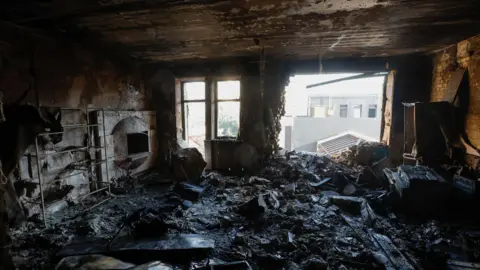 This flat was demolished when a Russian drone hit a residential building in Kyiv