
Mazzaltov World News provides you with the latest live coverage of Current Affairs, Sports, Health, Weather, Entertainment, Business and Travel News from around the world.
Here’s where things stand on Sunday 20 July 2025:
Fighting
- Russian forces launched a missile attack on Ukraine’s Dnipropetrovsk region, killing two people and damaging “an outpatient clinic, a school and a cultural institution”, according to the central region’s governor, Serhiy Lysak.
- Another Russian missile attack on the Black Sea port of Odesa killed at least one person overnight and wounded six others, including six children, officials said.
- Ukrainian President Volodymyr Zelenskyy said Russian forces launched “more than 300 strike drones and over 30 missiles” against Ukrainian cities during the overnight attack.
- The attacks also damaged critical infrastructure in the Sumy region, “leaving several thousand families without electricity”, the Ukrainian president added.
- In Russia, the Mayor of Moscow, Sergei Sobyanin, said early on Sunday that Russian air defences downed at least 15 Ukrainian drones heading for the capital.
- Russia’s Ministry of Defence said early on Sunday that its air defence units destroyed 40 Ukrainian drones, including 21 over the Bryansk region, on the Ukrainian border.
- This came hours after the ministry said its air defence units shot down six missiles and 349 drones over Russian territory on Saturday.
- Earlier, Russia had to suspend trains for about four hours overnight in the southern Rostov region when it came under a Ukrainian drone attack, which injured one railway worker.
- The acting governor of the Rostov region, on Ukraine’s eastern border, said Ukrainian drones had also caused fires and knocked down power lines.

Politics and diplomacy
- Zelenskyy said Ukraine sent Russia a proposal offering a new round of peace talks to take place next week, after negotiations stalled last month.
- Ukrainian Foreign Minister Andrii Sybiha accused Russia of deporting Ukrainians to Georgia and leaving them stranded there without proper documents, hundreds of miles from their home. He said Ukraine has brought back 43 people so far, but more people remain in “difficult conditions” at the border.
- Earlier, Volunteers Tbilisi, an aid group, said at least 56 Ukrainians, mostly prisoners who completed their sentences and were subsequently ordered to leave Russia, were being held in “inhumane” conditions in a basement near the Russian-Georgian border.
- India said it did not support “unilateral sanctions” by the European Union, after Brussels imposed penalties on Russia that included a Rosneft oil refinery in the western Indian state of Gujarat.

Ukrainian emergency service workers extinguish a fire in a residential building after Russian shelling, in Kostiantynivka, Ukraine, on Saturday
Zelenskyy says Ukraine sent Russia offer of new peace talks
Ukrainian leader also reiterates readiness for face-to-face meeting with Russia’s Vladimir Putin.

Ukraine has proposed to hold a new round of peace talks with Russia next week after negotiations stalled last month.
President Volodymyr Zelenskyy confirmed on Saturday that Defence Council secretary Rustem Umerov made the offer of a meeting with Russian negotiators for next week.
“Everything should be done to achieve a ceasefire,” Zelenskyy said in his evening address to the nation. “The Russian side should stop hiding from decisions.”
Ukraine’s leader also reiterated his readiness to have a face-to-face sit-down with Putin. “A meeting at the leadership level is needed to truly ensure peace – lasting peace,” he said.
There was no immediate response from Russia.
Umerov, a former defence minister, was appointed last week as the head of the National Security and Defence Council and tasked with adding more momentum to the negotiations.
He headed his country’s delegation in two previous rounds of talks in Turkiye earlier this year, which yielded little more than an agreement to exchange prisoners and soldiers’ remains.
In previous rounds, Russia outlined a list of hardline demands that were not acceptable to Ukraine, calling on it to cede four Ukrainian regions it claims as its own and reject Western military support.
However, Kremlin spokesperson Dmitry Peskov on Friday indicated that Moscow agreed with a statement by Zelenskyy that peace efforts needed “more momentum”.
The shift came after United States President Donald Trump, who initially appeared to adopt a conciliatory approach towards Russia after entering office, upped the pressure on Moscow.
This week, Trump set a 50-day deadline for Moscow to reach a ceasefire in Ukraine or face “100 percent tariffs” and the prospect of secondary sanctions being imposed on countries that buy Russian oil.
He also promised to ramp up arms shipments to the war-battered country.
Maria Zakharova, a spokesperson for the ministry, said on Thursday that Russia would not accept the “blackmail” of Washington’s sanctions ultimatum, and the decision to resume weapons deliveries was a signal to Ukraine to “abandon the peace process”.
Ongoing exchange of fire
Kyiv extended its invitation for more talks with Moscow after Russian forces staged a massive drone attack on the Ukrainian Black Sea port city of Odesa early on Saturday, killing at least one resident and injuring six others, according to Zelenskyy.
Posting on X on Saturday, the Ukrainian president said Russia launched more than 30 missiles and 300 drones during its overnight assault that affected 10 regions of the country.
Russia, meanwhile, had to suspend trains for about four hours overnight in the southern Rostov region when it came under a Ukrainian drone attack, which injured one railway worker.
On Saturday, Moscow Mayor Sergei Sobyanin said on Telegram that Russian air defence systems shot down three drones en route to the city.
Two Moscow airports – Vnukovo and Domodedovo – suspended arrivals and departures for safety reasons, but later resumed operations, Russian aviation watchdog Rosaviatsia said.
The Russian Defence Ministry said its air defence systems intercepted and destroyed 27 Ukrainian drones in total from 3pm to 7pm Moscow time (12:00-16:00 GMT).
Russia’s invasion of Ukraine in February 2022 has led to Europe’s bloodiest conflict since World War II, with estimates suggesting 1.2 million people have been wounded or killed.
Moscow airports temporarily closed after Ukraine drone attacks

A sustained Ukrainian drone attack on Russia caused Moscow’s major airports to be temporarily closed and saw at least 140 flights cancelled, officials said.
More than 230 Ukrainian drones were downed over Russia since Saturday morning – including 27 over the capital – according to the Russian defence ministry.
According to Russia’s aviation watchdog, the four major airports serving the capital were disrupted and more than 130 flights also had to be redirected. All have since resumed normal operations.
Meanwhile, at least three people were killed during Russian air strikes on Ukraine overnight, according to regional officials.
Russia’s Association of Tour Operators (Ator) said on Sunday that Moscow airports were closed 10 times in 24 hours due to the strikes.
The Kaluga region, southwest of Moscow, was also affected. Russia’s defence ministry said it had intercepted 45 drones since Saturday morning, resulting in Kaluga International Airport also being temporarily closed.
Russia’s defence ministry said drones were also shot down over regions near the Ukrainian border including Rostov and Bryansk, as well as over the Black Sea. No fatalities were reported.
This is not the first time that Ukrainian drone attacks have caused travel disruption in Russia. In May, at least 60,000 passengers were stranded at airports across the country after Kyiv launched more than 500 drones in a 24-hour period, according to Russia’s defence ministry.
Regional officials in Ukraine said two people died after Russian air strikes in different parts of Donetsk, while a 78-year-old woman died after residential buildings burned down in Sumy.
Ukraine’s air force said it shot down 18 out of 57 Russian drones overnight into Sunday, while a further seven drones were lost after their radars were jammed.
As well as Sumy and Donetsk, other front-line areas of Kharkiv and Dnipropetrovsk were attacked, as was Zaporizhzhia.
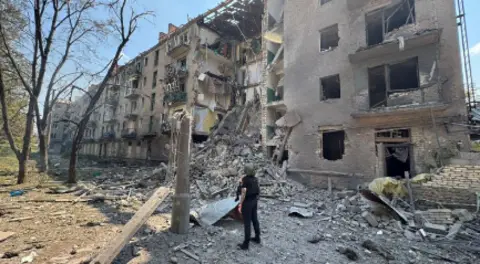
The latest attacks come as the Kremlin’s spokesman, Dmitry Peskov, said that Russian President Vladimir Putin was ready to move towards a peace settlement with Ukraine but that Moscow’s priority was to “achieve our goals”.
“President Putin has repeatedly spoken of his desire to bring the Ukrainian settlement to a peaceful conclusion as soon as possible. This is a long process, it requires effort, and it is not easy,” he said in a televised interview.
It has been nearly three-and-a-half years since Moscow launched its full-scale invasion of Ukraine.
On Saturday, Ukrainian President Volodymyr Zelensky proposed a new round of talks with Moscow, aimed at restarting negotiations that halted last month.
Previous attempts by Russia and Ukraine to negotiate an end to the fighting have failed to achieve a ceasefire, but have resulted in prisoner swaps.
Zelensky also repeated his readiness to meet Russia’s Vladimir Putin face-to-face, saying: “A meeting at the leadership level is needed to truly ensure peace.”
Ukraine was this week given a boost when US President Donald Trump – who has in the past often expressed support and admiration for Russia’s leader – announced that the US would send “top-of-the-line weapons” to Ukraine via Nato countries.
Trump also threatened Russia with severe tariffs if a deal to end the war is not reached within 50 days, and later told the BBC that he was “disappointed” with Putin but “not done”.
Reacting to this in Sunday’s interview, Peskov said: “Everyone has grown accustomed to his [Trump’s] rather harsh and straightforward rhetoric.
“At the same time, he reaffirms his intention to continue doing everything possible to facilitate a peaceful settlement.”
Buildings burn as another wave of Russian attacks hits Ukraine

At least three people have died following another widespread air bombardment by Russia.
Two people were killed in the eastern Dnipropetrovsk region, the regional head, Serhiy Lysak, said, while a woman died of her injuries after being rescued from a burning apartment in Odesa, according to emergency services.
President Volodymyr Zelensky said 10 regions of Ukraine, including a number of cities, were hit in the overnight assault. Ukraine’s military said more than 340 explosive and dummy drones and 35 cruise and ballistic missiles were used.
Although it said 90% of these were shot down, suppressed electronically or lost, more than 30 got through.
One of the strikes hit a residential block in the southern city of Odesa, causing a fire on its upper floors.
Rescuers said five people were rescued from burning apartments – including the woman who later died. At least another six people were wounded.
The eastern city of Pavlohrad was subjected to what Serhiy Lysak called a “hellish night and morning”.
He said there had been “explosion after explosion” caused by drone and missile strikes, adding it had been the biggest-scale attack on the city to date.
Targets reportedly included industrial sites, a fire department, a clinic, a school, and a cultural institution.
Zelensky wrote of “important infrastructure” being damaged there. A missile plant is based in Pavlohrad, and the city has been struck in the past by Russia.
Russia’s defence ministry said it struck military-industrial enterprises that produce components for missiles and drones overnight, but did not specify where.
The north-eastern city of Sumy was also attacked. Zelensky said critical infrastructure had been damaged, cutting power to several thousand families.
There have also been strikes – including with guided bombs – on another town in the region, Shostka, which lies less than 50km (30 miles) from the Russian border. Officials said a “targeted hit” there had caused a fire. They did not say what had been struck.
Unverified video footage posted online purportedly of the incident shows a fierce fire and billowing clouds of grey smoke.
Zelensky once again stressed the importance of bolstering air defences, both in terms of supplies from allies, but also producing them in Ukraine, including more interceptor drones.
The Trump administration recently moved to free up weapons supplies, even if some of these – including much-needed Patriot air defences – will be paid for by other Nato allies.
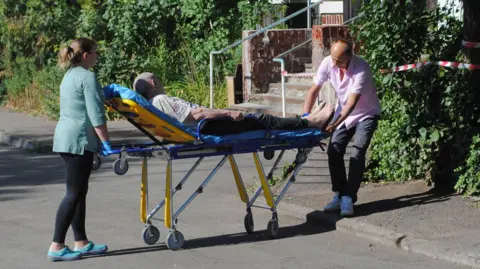
Russia said it shot down more than 70 Ukrainian drones overnight into Saturday, most of them over the regions of Rostov, Moscow and Bryansk.
The acting governor of Rostov, Yuri Slyusar, said the attack had been massive, affecting areas close to the border with occupied parts of Ukraine. Houses, he said, were damaged by what he said had been falling debris, and several settlements suffered temporary power cuts.
Slyusar said one railway worker had been injured, and rail traffic disrupted. Several supply routes into Ukraine run through the area.
Meanwhile, on the front lines, Russian forces continue to attack one of their key objectives – the town of Pokrovsk in the eastern region of Donetsk.
Late on Friday, Ukraine’s commander-in-chief, Oleksandr Syrskyi, acknowledged it faced increasing pressure, but insisted its defence was “steadfast”. He said Russia had been trying to get to the city with small groups of soldiers attacking for sabotage and reconnaissance purposes, claiming one such group had been destroyed. Russia has been trying to encircle Pokrovsk for months.
Russia launched a full-scale invasion of Ukraine in February 2022.
UK sanctions Russian spies for malicious activity
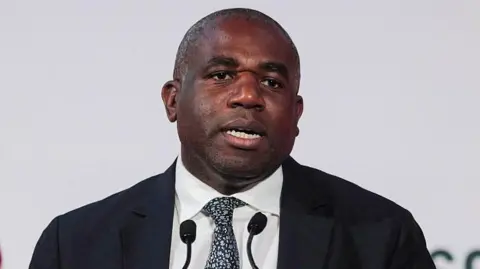
A number of Russian spies have been sanctioned for conducting a “sustained campaign of malicious cyber activity” including in the UK, the Foreign Office has said.
Three military intelligence units from Russia’s GRU espionage agency and 18 officers have had sanctions placed on them for allegedly “spreading chaos and disorder on [Russian President Vladimir] Putin’s orders”.
UK Foreign Secretary David Lammy linked the activity to the UK’s continued support of Ukraine, and said GRU spies were “running a campaign to destabilise Europe”.
Separately, the European Union placed its “strongest sanctions” yet on Russia, which Ukrainian President Volodymyr Zelensky called “essential and timely”.
The latest EU measures, announced on Friday, included a ban on transactions related to the Nord Stream natural gas pipeline and lowering a cap on the price at which Russian oil can be bought.
The UK joined the move to lower the price cap, with Chancellor Rachel Reeves saying Europe was “turning the screw on the Kremlin’s war chest”.
They come as European allies hope to ratchet up the pressure on Russia to bring the three-year-long war in Ukraine to an end.
But former Russian President Dmitry Medvedev, a close ally of Putin, said his nation’s economy would survive the sanctions and that Moscow will continue striking Ukraine “with increasing force”.
The EU sanctions are the 18th round of such measures since Russia’s full-scale invasion of Ukraine began in 2022.
The aim is to undermine Moscow’s ability to finance its war on Ukraine – something Western sanctions have so far failed to achieve, as Russia has increased its oil exports to China and India and operates a so-called shadow fleet of oil tankers around the globe.
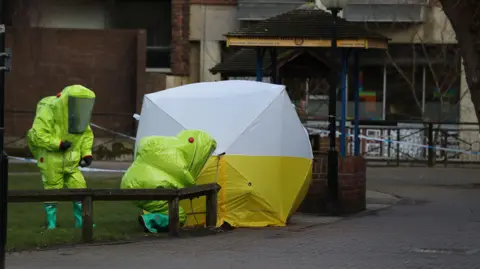
Whitehall officials say today’s sanctions imposed by the UK on 18 Russian GRU military intelligence officers is “the biggest action against Russian spies” since the aftermath of the Salisbury Novichok poisonings in 2018.
The latter was more significant as it involved the wide scale expulsion of Russian “diplomats”, whereas those GRU officers outed today are presumed to be back in Russia.
The UK Foreign Office said one of the intelligence units it had sanctioned – Unit 26165 – had been involved in targeting Mariupol, including a strike that hit the Ukrainian city’s theatre, killing hundreds of civilians.
It said it had also placed measures on intelligence officers who placed spyware on the phone of Yulia Skripal, who with her father was targeted by suspected Russian agents in Salisbury with the nerve agent Novichok.
The Foreign Office added that Russia had targeted UK media organisations, telecoms companies, energy infrastructure and political institutions.
“The Kremlin should be in no doubt: we see what they are trying to do in the shadows and we won’t tolerate it,” Lammy said in a statement. “Putin’s hybrid threats and aggression will never break our resolve.”
People or entities that are sanctioned can face a range of restrictions, including having financial assets frozen.
European leaders are also looking for the US to place further pressure on Russia.
Earlier this week, Donald Trump threatened Russia with severe tariffs if a peace deal was not reached within 50 days. The US president has become increasingly impatient with Putin.
The Foreign Office also announced sanctions on three leaders of the “African Initiative”, a social media campaign it said was founded, funded and employed by Russia to conduct disinformation operations in West Africa.
Russia has previously denied any involvement in efforts to interfere with countries’ democratic systems or of seeking to sabotage their economies.