
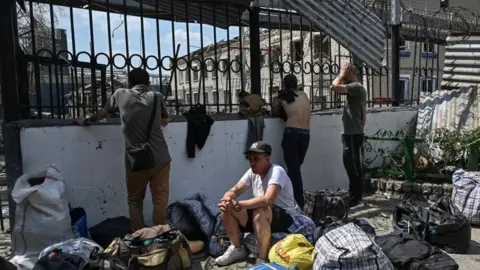
At least 25 people have been killed across Ukraine in overnight and early morning Russian air strikes that hit a prison and a hospital, local officials say.
They say the deadliest attack was on the Bilenke penitentiary in the southern Zaporizhzhia region, where 16 inmates were killed and more than 50 injured.
A separate Russian strike on people queuing for humanitarian aid killed five in the north-eastern Kharkiv region. Three people were killed in the central Dnipropetrovsk region, including a pregnant woman. Another casualty was reported elsewhere in the region.
Later on Tuesday, Donald Trump confirmed a deadline of 8 August for Russia to agree a ceasefire, or else face sweeping sanctions.
The US president had issued an ultimatum to Moscow on Monday during a visit to the UK, saying he would reduce the 50-day deadline previously issued to Russian President Vladimir Putin earlier this month.
In response to the overnight strikes on Ukraine, Zelensky said Russia “must be forced to stop the killings and make peace” via “tough” sanctions.
In a statement on Tuesday morning, Ukraine’s justice ministry said four glide bombs hit the Bilenke penitentiary shortly before midnight, destroying the dining hall, administrative headquarters and quarantine area.
It said that more than 50 people were injured, and 44 of them had to be taken to hospital.
The ministry had earlier reported 17 inmates were killed but later amended the death toll.
Ukraine’s human rights commissioner said attacking a prison was a gross violation of humanitarian law as people in detention did not lose their right to life and protection.
Russian forces have frequently targeted the front-line region of Zaporizhzhia since the start of the full-scale invasion of Ukraine in 2022.
It is one of four south-eastern regions in Ukraine that Russia claims to have annexed since 2022, although Moscow does not fully control any of them.
In a separate Russian rocket attack on Tuesday morning, five people were killed in the village of Novoplatonivka, Kharkiv region, the local authorities said.
The villagers had gathered near a local shop to get humanitarian aid, regional police chief Petro Tokar told Ukraine’s Suspilne TV channel.
Ukraine’s officials later released photos showing bodies lying near a destroyed shop.
Another Russian rocket strike hit a hospital in Kamianske, Dnipropetrovsk region, killing three people.
A 23-year-old pregnant woman named Diana was among the casualties there, President Zelensky said.
In a statement, he accused Russia of killing Ukrainians when a ceasefire “could have long been in place”.
Earlier in July, Trump set a 50-day deadline for the Kremlin to reach a truce with Kyiv or risk economic penalties, but the warning has not halted Russia’s barrage of strikes.
The wave of attacks came as Russia said its troops were pushing deeper into Ukrainian territory.
At the weekend, Moscow said its forces had seized the village of Maliivka, weeks after claiming control over their first village in the Dnipropetrovsk region. Ukraine has rejected Russia’s claims.
Meanwhile, in Russia, officials said Ukraine had launched dozens of drones overnight in the southern Rostov region, killing one person in their car in the town of Salsk and setting fire to a goods train.
Another person was reported killed in their car in the border region of Belgorod and his wife was wounded.
Putin must agree Ukraine ceasefire in 10 or 12 days, says Trump
Putin must agree Ukraine ceasefire in 10 or 12 days, says Trump
US President Donald Trump has presented a new, shorter deadline for Russia to agree to a ceasefire over the war in Ukraine of “ten or 12 days” from Monday.
President Trump said there was “no reason” in waiting any longer as no progress towards peace had been made. Ukrainian President Volodymr Zelensky called the intervention “extremely significant”.
Two weeks ago, Trump said President Vladimir Putin had 50 days to end the war or Russia would face severe tariffs.
Speaking at a news conference in Scotland, Trump said he would confirm the new deadline on Monday or Tuesday, but reiterated the threat to impose sanctions and secondary tariffs on Moscow.
Zelensky thanked Trump for the adjusted deadline, saying it came “right on time” in a social media post on X. He praised the US president’s “clear stance and expressed determination” on “saving lives and stopping this horrible war”.
Earlier in July he said those would amount to 100% tax imposed on any country that trades with Russia.
This would make the goods so expensive that US businesses would likely choose to buy them cheaper from elsewhere, resulting in lost revenue for both Russia and the country that trades with it.
Speaking after a meeting with UK Prime Minister Keir Starmer in Scotland, Trump again expressed his disapproval at Putin’s actions in Ukraine, where war rages on three and a half years into Russia’s full-scale invasion.
While he refused to say whether he felt Putin had been “lying” to him, Trump highlighted the contrast between the Russian president’s rhetoric during their one-on-one conversations and the missiles “lobbed” on Ukrainian cities on a near-nightly basis.
“We were going to have a ceasefire and maybe peace… and all of a sudden you have missiles flying into Kyiv and other places,” Trump lamented, adding that he thought negotiations would be possible but that it was now “very late down the process”.
“I say, forget it. I’m not gonna talk anymore. This has happened on too many occasions and I don’t like it,” he said, though he also insisted that he and Putin always got along very well.

Trump also said he was “no longer interested in talks” – a line which instantly flashed up on major Russian media outlets.
Putin has never commented on the timeframe. When the initial 50 days deadline was first announced, Kremlin spokesman Dmitry Peskov merely labelled it as “very serious” but added that Moscow needed time to analyse it.
Referring to the latest developments on Monday afternoon, Russian MP Andrey Gurulyov said Trump’s ultimatums “didn’t work anymore… not on the front line, not in Moscow” and that Russia had the force of its “weapons, principles and will”.
When Trump first mentioned shortening the deadline Ukrainian presidential chief of staff Andriy Yermak praised him for “delivering a clear message of peace through strength” and added that Putin “respects only power”.
In recent months Russia has ramped up its attacks on Ukraine, launching swarms of drones and missiles on cities while pressing on with its summer offensive in the east of the country.
Three rounds of ceasefire talks between Russia and Ukraine hosted by Turkey have resulted in thousands of prisoners of war being exchanged – but no real progress was made towards agreeing a ceasefire.
After three and a half years of bloody conflict, it is unclear how the two sides could possibly reach an agreement to stop the fighting within 12 days.
All of Russia’s preconditions for peace – including Ukraine becoming a neutral state, dramatically reducing its military and abandoning its Nato aspirations – are unacceptable to Kyiv and to its Western partners.
At the last week’s round of talks, which lasted barely an hour, Peskov said a “breakthrough” in negotiations was “hardly possible”.
Russian missile hits Ukrainian training unit, killing and wounding servicemen
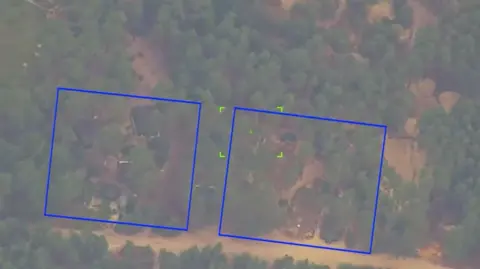
Ukraine’s armed forces have confirmed a Russian missile strike hit a military training unit, causing a number of casualties.
Ukrainian ground forces said late on Tuesday that three service personnel were known to have been killed and 18 had been wounded.
The military did not say where the training ground was located, although one Ukrainian war reporter, Andrei Taplienko, said it was in the Chernihiv region north of Kyiv which borders both Russia and Belarus.
Russia’s ministry of defence released video of what it claimed was a strike by an Iskander ballistic missile in a wooded area that involved more than 20 cluster-type explosions.
The video could not be immediately verified but the Russian MOD claimed that the number of Ukrainian casualties was far higher than Ukraine’s military had said. There has been no further word from the military since late on Tuesday.
“Despite the security measures taken, unfortunately it was not possible to completely avoid losses among the personnel,” Ukraine’s ground forces said in a statement on social media.
It is the third Russian attack on a Ukrainian training unit in little more than two months.
An Iskander missile attack on a camp in the norther border region of Sumy killed six servicemen in May and another strike killed 12 people and wounded another 60 last month.
Protecting Ukrainian troops on exercises is particularly sensitive for the military, which said it would investigate whether the “actions or inaction of officials” had led to deaths or injuries in Tuesday evening’s missile strike.
The commander of ground forces Mykhailo Drapatyi resigned after last month’s deadly attack, saying that the victims had been “young guys from a training battalion” and that most of them had been in shelters at the time.
In a separate development, Russian forces targeted the regional military administration building in Sumy on Wednesday, wounding a 75-year-old woman, officials said. The same building was hit last Saturday when a drone smashed into the large office block, although nobody was hurt.
Meanwhile, Ukrainian authorities said a sixth person died in hospital from wounds he suffered during a Russian missile strike on a humanitarian aid point in the Kharkiv region on Tuesday.
Ukrainian reports said that four men and two women were fatally wounded while queuing for water. Officials said the missile started a fire that engulfed a shop in the village of Novoplatonivka.
‘They chase ambulances:’ Russia’s ‘record’ attacks on Ukraine’s healthcare
Emergency healthcare workers in wartorn Ukraine say they have been targeted by drones.

As luck would have it, emergency doctor Elina Dovzhenko was far enough from her vehicle when a Russian drone struck it, breaking the windshield and splattering pieces of shrapnel around.
It was getting dark on July 9 in the bombed-out, nearly-abandoned city of Kupiansk which sits less than 5km (3 miles) from the front line in the northeastern Ukrainian region of Kharkiv – and just 40km (25 miles) west of the Russian border.
But there was definitely enough light left for the Russian drone operator on the front line’s opposite side to see that Dovzhenko’s vehicle was a white ambulance with red stripes parked near a shelling-damaged hospital where she and her colleagues were.
“We heard the drone move, it swirled and swirled around [the building], then we heard the blast,” Dovzhenko, 29, told Al Jazeera.
She and her colleagues were shocked and angry – but not surprised. They have been hearing regularly about Russian drones targeting ambulances, rescue workers and the people they were rescuing, mostly the elderly who refused to leave their homes, pets, kitchen gardens and family graves.
“They chase ambulances every other day. They definitely targeted us,” Denys Raievskyi, a 30-year-old paramedic and Dovzhenko’s ambulance partner, told Al Jazeera.
Their job is among the most dangerous professions in wartime Ukraine – some 200 ambulances have been damaged or destroyed by Russian shelling attacks each year since the full-scale invasion began in 2022, the World Health Organization (WHO) said in April.
Ambulances workers and other personnel servicing health transport face a risk of injury and death three times higher than that of other healthcare service workers,” it said.
Premeditated, systematic attacks on ambulances are part of the Kremlin’s wider strategy to destroy Ukraine’s medical facilities and deprive millions of access to healthcare exacerbating their stress as well as physical and mental health problems.
Some 68 percent of Ukrainians already report a decline in their health compared with the pre-war period, the WHO said, and 46 percent are concerned about their mental health.
The WHO did not specify the number of casualties among ambulance workers, but said that since 2022 it has verified 1,682 attacks on healthcare facilities and workers in Ukraine that have resulted in 128 deaths and 288 injuries of health professionals and their patients.

Children in the line of fire
In an earlier assessment last August, it said the number of attacks was “the highest number WHO has ever recorded in any humanitarian emergency globally”.
“These attacks are a deliberate crime against humanity aimed at destroying civilians and those who stand on the front line fighting for [their] lives,” Ukraine’s Health Ministry said in July 2024.
The statement followed last year’s July 8 strike that killed two hospital workers, wounded eight children and injured hundreds in Okhmatdyd, Ukraine’s largest children’s hospital in Kyiv.
Russia used an X-101 missile that flies low to avoid detection and air defence, manoeuvres mid-flight and hits its target with a 10-metre (33ft) accuracy even if launched from 5,500km (3,420 miles) away.
Moscow routinely denies responsibility for deliberate attacks on healthcare, claiming it only strikes military sites and personnel.
International relief groups say they are aware of the gravity of the situation and are ready to keep supporting Ukraine’s healthcare.
“Unfortunately, these types of situation are not new,” Giorgio Trombatore, regional director for Eastern Europe with Project Hope, an international humanitarian group, told Al Jazeera. “But we are resilient, we’re going to continue.”
The group maintains 13 ambulances in four Ukrainian regions, five of them in Kharkiv – including the one struck by the drone in Kupiansk.
Other ambulances have also encountered drones in recent months, but the teams were not hurt.
“That’s something you cannot escape; eventually you need to be prepared,” Trombatore said. “Luckily, we didn’t report casualties from our team.”
His group also provides helmets and flak jackets, and some of the ambulances are bulletproof – something that helps counter Russia’s tactic of repeated strikes.
In one case, a Russian drone attack killed a civilian and wounded another in the village of Stetsivka in the northern region of Sumy on July 14.
After the ambulance team, supported by Project HOPE, arrived, a second drone exploded 2 metres (7ft) away from the vehicle.
“What saved them is that the vehicle was bulletproof,” Project HOPE’s spokesman Artem Murach told Al Jazeera.

‘Hope and faith’
The city of Kupiansk straddles both banks of the slow and strategically-located Oskil river, and once boasted a dozen factories, several colleges and a population of 22,000.
But days after the full-scale invasion of Ukraine began in 2022, the mayor surrendered the town and it became the de facto administrative centre of the Moscow-occupied chunk of the Kharkiv region.
The Russians were kicked out six months later during a daring Ukrainian counter-offensive.
But the town remained within reach of Russian artillery, drones and missiles, which have killed dozens of civilians, wounded hundreds and damaged almost every building.
Most of the residents – along with police officers, fire brigades and government officials – fled Kupiansk in early 2023 when Russian forces began approaching again.
But about 1,200 people – or about 7 percent of the pre-war population – remained.
“They’re scared to leave, they have no relatives to host them, they say, ‘I’d better die here, because it’s home,’” paramedic Raievskyi said.
He is no stranger to Russian pummelling – he lives with his wife in Saltivka, the most shelling-damaged region of Kharkiv, Ukraine’s second-largest city some 120km (75 miles) east of Kupiansk.
Raievskyi’s ambulance travels up to 1.5 hours to help the sick and the wounded, despite the almost constant shelling and omnipresent drones.
But no matter how severe their wounds are, he and his colleagues can’t treat their patients on the spot, especially if they have been hurt by a drone, because another strike is always a possibility.
One life-saving solution – a portable electronic jamming system that scrambles the drones’ navigation systems – no longer works in the Kharkiv region because Russians attach kilometres-long fibre-optic cables to their loitering munitions.
“Unfortunately, in Kupiansk all the Russian drones are fibre-optic,” his partner Dovzhenko said.