
Mazzaltov World News provides you with the latest live coverage of Current Affairs, Sports, Health, Weather, Entertainment, Business and Travel News from around the world.
Here’s where things stand on Monday 2 June 2025:
Summary
- Ukraine and Russia are sending delegates to Istanbul for a second round of peace talks today
- Over the weekend, Kyiv launched 117 drones on Russian air bases after the largest-ever aerial attack on Ukraine
- Ahead of Monday’s talks, Ukrainian President Volodymyr Zelensky has said Moscow is “doing everything it can to ensure the next possible meeting is fruitless”
- An earlier round of talks in Istanbul last month failed to bring about any significant outcome apart from a prisoner of war swap
- Zelensky also noted that Moscow had not provided its negotiation proposals before the meeting but Russian media reported on Sunday that a delegation had departed for the talks in Turkey
Little hope of breakthrough in today’s talks
After more than three years of war, Russia and Ukraine remain far apart, and few expect a breakthrough in the second round of direct talks in Istanbul.
Russia has, so far, rejected Ukraine’s call for an unconditional ceasefire before discussing the terms of a long-term truce.

Russia has not made public its conditions ahead of today’s meeting, but officials have continued to voice demands already rejected by Ukraine, including limiting the size of the Ukrainian army and recognition of Ukrainian territory seized by Russia, including Crimea.
Ukrainian officials have accused Russian President Vladimir Putin of delaying tactics in the negotiations, and some suspect he is not really interested in pausing or ending the conflict.
Russia has intensified its attacks on Ukraine in recent weeks, and Ukraine says there are signs Russia is planning a summer offensive, to try to capture more Ukrainian land.

Both sides are under pressure from President Trump to reach a deal and are keen to show they back his efforts: Ukraine, which wants the violence to stop, needs American military aid, while Russia hopes to see the easing of economic sanctions.
The first round of talks resulted in little more than a prisoner exchange deal.
Sunday’s large-scale Ukrainian attack on air bases deep inside Russia is a message from Ukraine to Russia and the West: the country is still fighting and is unlikely to make concessions it considers unacceptable.
At least 13 Russian planes were destroyed in Sunday’s attack – Ukrainian official
We’ve just seen an update on the messaging app Telegram from Andriy Kovalenko, who is the head of Ukraine’s Centre for Countering Disinformation.
He says at least 13 Russian aircraft were destroyed by Sunday’s drone attack and adds that other military planes were damaged.
As we reported earlier, Ukraine claimed to have hit more than 40 Russian bombers yesterday, in one of the most audacious attacks so far on Russian aviation.
Attacks on Ukraine continued last night
The night before the talks, Russia attacked Ukraine with 80 drones, three ballistic missiles and one cruise missile, Ukraine’s Air Force says.
According to the military, 52 of the drones were intercepted or lost without causing any damage.
The number of drones used by Russia last night is much lower than the record-breaking amount (472) the night before.
What happened during the last round of talks?
Officials from Kyiv and Moscow met in Istanbul just last month for their first face-to-face talks in three years.
While the brief meeting saw them agree to swap 1,000 prisoners of war, it yielded little else in terms of bringing the war to an end.
Neither Russia’s President Putin nor Ukraine’s President Zelensky were in attendance. The latter criticised the delegation sent from Moscow as “low-level”.
US President Donald Trump was also absent despite being initially expected to attend – and said at the time that no significant progress could be expected until he and Putin met.
After the talks, the leader of Russia’s delegation Vladimir Medinsky said he was “satisfied”.
He said Russia had “taken notice” of Ukraine’s request for direct talks to take place between Putin and Zelensky, and that both sides would present their “vision of a possible future ceasefire”.
But a Ukraine foreign ministry spokesperson said the Kremlin made “new and unacceptable demands” – including insisting Kyiv withdraw its troops from large parts of its own territory, he said, in exchange for a ceasefire.
The lavish surroundings of Ciragan Palace are today’s setting

This is where the talks will be happening – the lavish surroundings of Ciragan Palace in Istanbul.
Ukraine’s delegation arrives in Istanbul for talks with Russia
We’ve just seen an update that Ukraine’s delegation has arrived in Istanbul for the latest round of peace talks with Russia, according to Heorhii Tykhyi – a spokesperson for Ukraine’s foreign ministry.
We’ll bring you the latest updates and analysis as we get it throughout the day.
Video appears to show drone attack on Russian military planes
Footage that appears to show the moment planes were set on fire at a military airbase on Sunday has been shown to the Reuters news agency by a Ukrainian security source.
The pictures in this short clip appear to have been filmed by a drone:
Ukrainian drones ’emerged from trucks’ before striking Russian bomber planes
Yesterday’s major drone attack by Ukraine on several Russian military airbases left more than 40 Russian bomber planes “burning”, according to the Security Service of Ukraine (SBU).
“Operation Spider’s Web” took one year-and-a-half to organise and was personally overseen by Ukrainian President Volodymyr Zelensky, the SBU said.
Sources said the drones were launched from trucks after being smuggled into Russia, stored on wooden pallets, loaded on to trucks, driven to distant airbases and launched remotely.
“Ukraine has conducted audacious attacks on Russia before – but this is a new level,” said the BBC’s diplomatic correspondent Paul Adams, writing from Kyiv.
Moscow has said Ukraine carried out a “terrorist attack” in five regions but claimed they were “repelled” and added that multiple participants had been arrested, according to Russia’s defence ministry.
Meanwhile, the weekend also saw the largest-ever aerial attack on Ukraine, as Russia continues its strikes, more than three years after Russian President Vladimir Putin launched a full-scale invasion of Ukraine in February 2022.
Ukraine and Russia talks set to take place in Istanbul
Ukraine and Russia are due to hold a second round of direct talks in Turkey today. Both countries have confirmed they have sent delegations to Istanbul.
Last month, the two countries held a first round of talks that brought no breakthrough, but achieved a prisoner of war swap.
Ukrainian President Volodymyr Zelensky has said Moscow is “doing everything it can to ensure the next possible meeting is fruitless” and also noted Russia had not provided its negotiation proposals before the meeting.
The talks come after Kyiv conducted “Operation Spider’s Web” over the weekend, launching 117 drones in an attack on Russian airbases, which our diplomatic correspondent has called one of Ukraine’s “boldest attacks so far”.
The Security Service of Ukraine (SBU) claims the attack struck 34% of Russia’s strategic bombers capable of carrying cruise missiles. The operation followed the largest-ever aerial attack on Ukraine by Russia the previous night.
Stay with us as we bring you the latest developments and analysis from Istanbul and the Ukrainian front.
Ukraine’s ‘Operation Spider’s Web’ strikes deep inside Russia’s borders
A swarm of Ukrainian drones have attacked a number of military airbases deep inside Russia’s borders and left more than 40 bomber aircraft in flames, according to Ukrainian officials.
Sources say FPV drones were smuggled into Russia, along with mobile wooden cabins. The cabins were carried by trucks with the drones hidden inside. The cabin roofs opened remotely – and then the drones took off and zoned in on the nearby bases.
Ukrainian President Volodymyr Zelensky described the operation as “an absolutely brilliant result” and said the Ukrainians’ actions will “undoubtedly be in the history books”.
He said planning for the operation began 18 months ago, and those involved “were withdrawn from Russian territory in time”.
Moscow said Ukraine carried out a “terrorist attack” in five regions but they were “repelled”. Russia’s defence ministry added multiple participants in the operation had been arrested.
Russian and Ukrainian officials are due to meet in Istanbul tomorrow but, as BBC Monitoring’s Russia editor Vitality Shevchenko writes, these attacks
This won’t necessarily change the course of Monday’s talks
Last night saw the largest-ever aerial attack on Ukraine, followed by Ukraine’s daring raid on bombers deep within Russian territory.
This shows that Russia is as keen to attack Ukraine as ever, and, in turn, President Zelensky is keen to prove wrong those who think – to use Donald Trump’s phrase – that he has “no cards”.
Extraordinary developments, but they won’t necessarily alter the course of talks on Monday. The people attending them are there to deliver and hear messages, but not to make big decisions.
All we know is that in the absence of progress on the diplomatic front, both Ukraine and Russia are more than willing to let the drones and missiles do the talking.
Attack serves as a reminder that Ukraine is a resourceful enemy
Far from Ukraine’s borders, an attack of astonishing audacity.
Russian strategic bombers picked off, one by one, by a fleet of tiny drones. Ukraine is calling this Operation Spider’s Web. Personally overseen by President Zelensky, it’s one of Kyiv’s boldest attacks so far.
A reminder, despite Russia’s overwhelming strength in numbers, that Ukraine is a resourceful, determined enemy.
Sources say it took a year and a half to prepare. Dozens of drones, smuggled into Russia. Stored on wooden pallets. Loaded onto trucks. Driven to distant airbases and launched remotely.
Swarms of drones were picked up on social media videos recorded from Siberia to the Arctic circle.
In one video, filmed at a petrol station north of Irkutsk, drones can clearly be seen taking off from a parked truck. And there’s gunfire, as police officers desperately try to bring it down.
With smoke rising from bases across Russia, Ukrainian sources said they had done $2bn (£1.5bn) worth of damage – a claim impossible to verify.
Earlier, it was Ukraine counting the costs.
Cities, including Zaporizhzhia, were targeted in another major drone and missile attack. Twelve Ukrainian soldiers were killed at a training base, leading the head of Ukraine’s land forces to tender his resignation.
What chance, then, for another round of peace talks, due to take place in Istanbul tomorrow?
Russian and Ukrainian delegations are expected to be there – but after 24 hours of mayhem, the omens for a breakthrough do not seem good.
Ukrainians involved in operation withdrawn from Russian territory ‘in time’ – Zelensky.
Earlier, Russian state-operated media outlet Tass reported that the driver of a truck believed to be involved in the drone attack will be questioned by police.
Russia’s defence ministry also says on Telegram that multiple participants in the operation had been arrested.
However, in his first statement since the drone operation took place, Ukrainian President Volodymyr Zelensky’s says the people involved in preparing the major drone attack “were withdrawn from Russian territory in time”.

Zelensky says operation HQ was ‘right next to the FSB’
Ukrainian President Volodymyr Zelensky has shared more details on the strike, saying 117 drones were used.
He says each drone had its own pilot.
“The most interesting thing – and we can already say this publicly – is that the ‘office’ of our operation on Russian territory was located right next to the FSB of Russia in one of their regions,” an English translation of his post on Telegram reads. The FSB is Russia’s security service.
He claims 34% of the cruise missile carriers at the targeted airfields were hit.
Zelensky: ‘Ukrainian actions that will undoubtedly be in history books’
We’re hearing from Ukraine’s President Volodymyr Zelensky for the first time about the drone strikes.
He’s just posted on social media calling today’s operation “an absolutely brilliant result” and one “achieved solely by Ukraine”.
“One year, six months, and nine days from the start of planning to effective execution,” he continues. “Our most long-range operation. Our people involved in preparing the operation were withdrawn from Russian territory in time.”
Zelensky says he met with the head of the the Security Service of Ukraine (SBU), Gen Vasyl Maliuk, and asked him to disclose the details and results of the operation to the public.
“Of course, not everything can be revealed at this moment, but these are Ukrainian actions that will undoubtedly be in history books,” he adds.
“Ukraine is defending itself, and rightly so – we are doing everything to make Russia feel the need to end this war. Russia started this war, Russia must end it. Glory to Ukraine!”
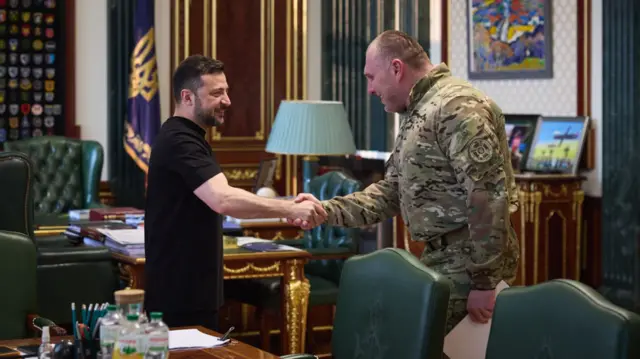
Ukraine’s SBU claims attack cost Russia $7bn
The Security Service of Ukraine (SBU) claims today’s attack on airfields in Russia has struck 34% of Russia’s strategic bombers capable of carrying cruise missiles.
In a post on social media, the SBU said its “Operation Spider’s Web” cost Russia $7bn (£5.2bn).
“We’re doing all we can to drive the enemy from our land! We’ll strike them at sea, in the air and on land. If necessary, we’ll get them from underground,” the SBU writes in a Telegram post.
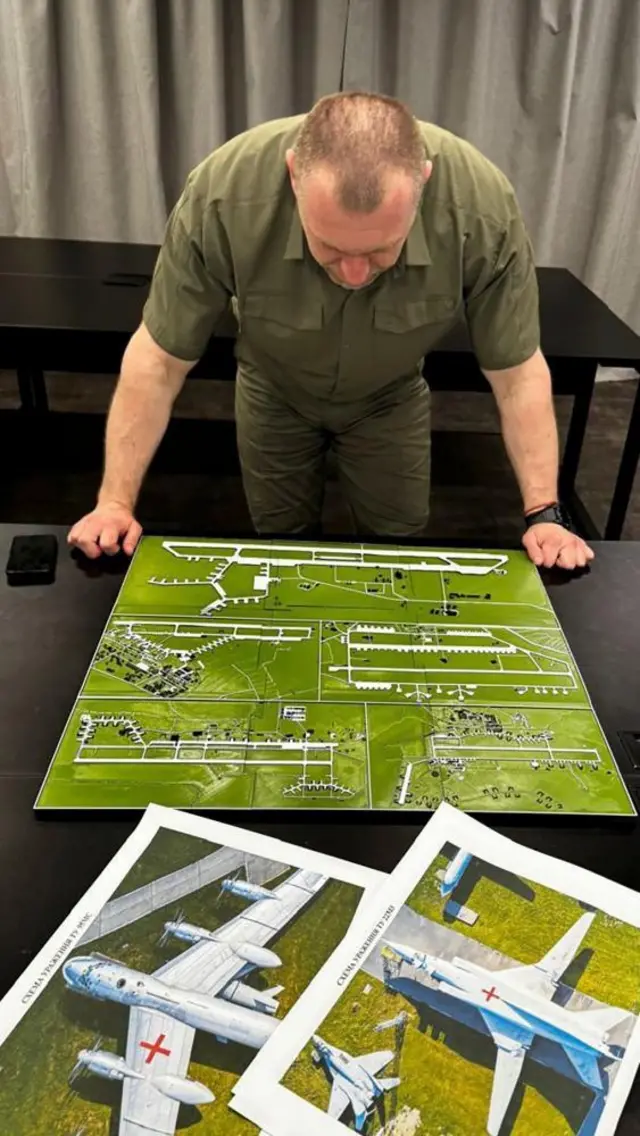
White House not warned in advance of strikes
We’re starting to see more reaction to Ukraine’s drone attack on Russian airfields earlier today.
While the White House has not yet responded to the attack, CBS News reports that the US government wasn’t given a warning about the strikes.
An administration source tells CBS News that the Trump administration was not “aware that today’s large-scale drone attack by Ukraine on the Russian military aircraft was coming”.
A look at life under Russian occupation in Ukraine
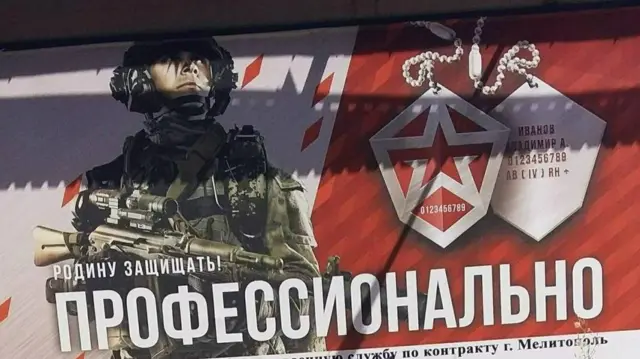
A fifth of Ukrainian territory is now under Russian control, and for Ukrainians living under occupation there seems little chance that any future deal to end the war will change that.
Ukrainians in different Russian-controlled cities have told the BBC of the pressures they face, from being forced to accept a Russian passport to the risks of carrying out small acts of resistance.
The potential dangers are the same, whether in Mariupol or Melitopol, seized by Russia in the full-scale invasion in 2022, or in Crimea which was annexed eight years before.
One woman, Mavka, says she chose to stay in Melitopol when the Russians invaded her city on 25 February 2022, “because it is unfair that someone can just come to my home and take it out”.
In recent months she has noticed a ramping up of not only a strict policy of “Russification” in the city, but of an increased militarisation of all spheres of life, including in schools.
Meanwhile, children at nursery school in Crimea are told to sing the Russian anthem every morning, even the very youngest. All the teachers are Russian, most of them wives of soldiers who have moved in from Russia.
Strikes could bring Russia ‘back to reality’ – Kyiv resident
We’re hearing a little from Ukrainians in Kyiv, who are responding to news of their country’s massive drone strikes on Russian bombers earlier.
Speaking to the Reuters news agency, construction worker Pavlo Fesenko says: “I think it will have huge influence … it can bring [Russia] back to reality and give us sort of a pause.”
However, he doesn’t think the strikes will translate into immediate results for Ukraine. “I do not think it will have influence we want it to be now. It is one of the steps that in future should lead to other talks where we should dictate terms,” Fesenko says.
He’s hopeful that this summer will be Ukraine’s “last war summer”, he adds.
“I hope they will not have new miracle or new resources from nowhere and that they will finally fall. That is when we will have different talks on different terms.”
Video appears to show drone attack on Russian planes
Footage showing several large aircraft on fire has been shown to the Reuters news agency by a Ukrainian security source.
Ukraine claims to have hit more than 40 Russian bombers, in what appears to be one of the most audacious attacks so far on Russian aviation.
The video shown to Reuters shows attacks on airfields in Russia’s Irkutsk and Murmansk regions, an unnamed security official identified as one of the agency’s anonymous sources says.
Russia confirms Ukraine carried out drone attacks on airfields
We’re now seeing an update from Russia’s Ministry of Defence acknowledging the strikes on airfields across five regions earlier today.
On Telegram, the ministry writes that Ukraine carried out what it said was a “terrorist attack” in the regions of Murmansk, Irkutsk, Ivanovo, Ryazan and Amur.
The ministry says that all of the attacks were “repelled”.
It says: “As a result of the launch of FPV drones from the territory located in the immediate vicinity of airfields, several pieces of aviation equipment caught fire.”
The fires have now been extinguished, it adds.
Russian authorities detain truck driver thought to be involved in attack
Russian state-operated media outlet Tass has reported that the driver of a truck believed to be involved in the drone attack will be questioned by police.
The report further adds that the “exact number of UAVs [drones] has not yet been counted”, but says there is no threat to the public at this time.
Attack comes on eve of renewed talks between Moscow and Kyiv
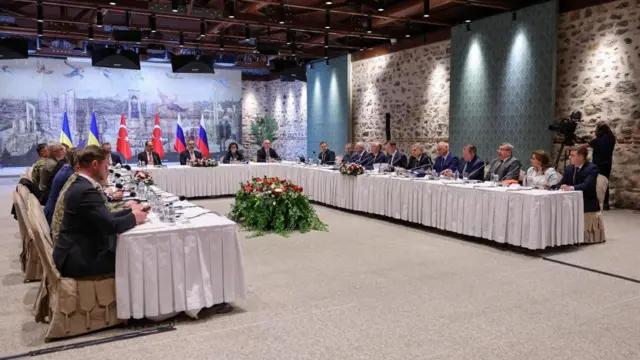
Ukraine’s attacks happen as a second round of direct talks between Ukrainian and Russian officials is scheduled to happen in Istanbul on Monday. This is part of revived diplomatic efforts, spearheaded by US President Donald Trump, for a ceasefire deal – and, eventually, an end to the war.
Before the attacks, it was already very difficult to see any kind of breakthrough in these negotiations, given how far apart both sides remain in their conditions. Their first round of talks, on 16 May, reached little more than an agreement for a prisoner exchange.
On Sunday, President Volodymyr Zelensky listed Ukraine’s positions for the talks that included a complete and unconditional ceasefire, the release of prisoners and the return of abducted children. Russia, so far, has rejected calls for an unconditional ceasefire and repeatedly made demands that have already been rejected by Ukraine.
Ukraine also says Russia’s refusal to share its terms ahead of the talks is part of a strategy to delay the negotiations. Russia, meanwhile, has intensified its air attacks against Ukraine in recent weeks, and officials in Kyiv have warned that Moscow may be preparing a new summer offensive. This, Ukrainian officials say, show Russia is not interested in a ceasefire.
Both countries have reason to demonstrate to President Trump they support his efforts for a deal: Ukraine wants more military aid from the US while Russia hopes the US will ease economic sanctions imposed on the country.
Zelensky’s top aide posts spider web emoji in apparent reference to attack
On social media a little earlier, Zelensky’s chief of staff, Andriy Yermak, made an apparent comment about his country’s massive drone operation.
Yermak posted an emoji of a spider web on both his Telegram channel and on X – seemingly a reference to the attack’s name of “Operation Spider’s Web”.
Russia’s major military assets shown to be vulnerable
These attacks will have dealt a significant blow to Russia’s aerial cruise missile strike capability.
Tu-95 bombers, which are among the type of aircraft that have been destroyed, are said to have launched a large-scale Kh-101 missile attack on Ukraine earlier this year. They have been used extensively since the full-scale invasion of February 2022 and so are a vital target for the Ukrainian military.
Each bomber can carry eight guided cruise missiles and each missile itself carries a 400kg (882lb) warhead. The weapons’ range is thousands of kilometres, which allows such strategic aircraft to deploy well inside the relative safety of Russian airspace.
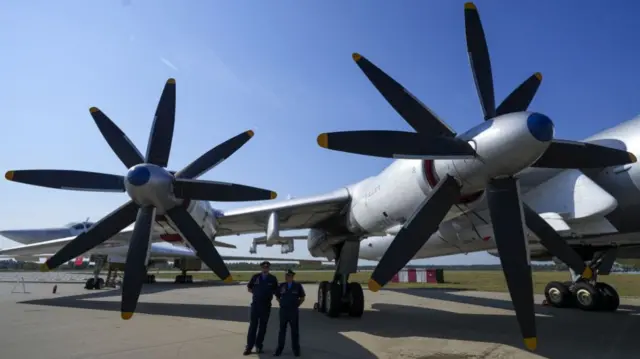
But just as significant is the reported loss of an A-50, the Russian equivalent of AWACS, whose role is to detect enemy aircraft and missiles, and feed those targets to Russian fighter jets. It performs a management role for aerial assets, by giving a big picture view and direction.
As for the strikes themselves, the use of drones in at least one, so close to the targets means that traditional Russian self-defence systems such as S-300 / S-400 long range SAMs, and even their shorter-range counterparts, Pantsir SA-22s, are ineffective. It also means that there was little warning that such an attack was coming to get aircraft to the relative safety of hardened shelters.
It may be that some of the Russian aircraft were not completely destroyed, and they can be repaired, but that still takes them – at the very least – out of the fight for a long time. More worrying for Moscow, it again points to the vulnerability of major military assets well inside Russian Federation territory itself.
Zelensky oversaw attack on Russian airbases, Ukrainian security sources say
Astonishing details have been leaked to the media about how this morning’s Ukrainian attack on at least four Russian airbases was organised.
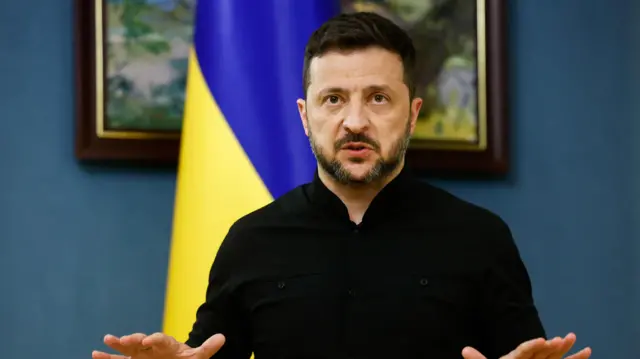
According to sources at the Security Service of Ukraine (SBU), “Operation Spider’s Web” took one year-and-a-half to organise and was personally overseen by Ukraine’s President Volodymyr Zelensky.
Sources say the SBU’s first smuggled FPV drones into Russia, followed later by mobile wooden cabins.
Once on Russian territory, the drones were hidden under the roofs of these cabins, which had been placed on to trucks. At the time of the attack, the roofs were remotely opened, allowing the drones to take off and hit the nearby airbases.
Video has emerged showing drones emerging from the roof of one of the vehicles involved. Ukraine estimates the damage caused by the attacks at over $2bn (£1.5bn).
The targets hit included TU-95s (the large strategic bomber known as “Bear”), TU-22M3s (supersonic long-range bomber) and A-50 (early warning and control aircraft).
In a separate development Ukraine’s head of land forces, Maj Gen Mkyhailo Drapatyi, has tendered his resignation, following a Russian ballistic missile attack which hit a Ukrainian army training facility earlier today, in which 12 soldiers were killed.
Drones were launched from a truck, Siberian governor says
We have some more from Irkutsk Governor Igor Kobzev, who has said that the drones that attacked the military base in Sredniy, in Siberia, were launched from a truck.
Kobzev posted on Telegram to say that the launch site had been secured and there was no threat to life.
Russian media outlets have also reported that other attacks were similarly started with drones emerging from the backs of lorries.
One thought on “LIVE UPDATES: Russia and Ukraine due to hold Istanbul talks after Kyiv’s smuggled drone attack”
Comments are closed.