
Mazzaltov World News provides you with the latest live coverage of Current Affairs, Sports, Health, Weather, Entertainment, Business and Travel News from around the world.
Here’s where things stand on Thursday 26 June 2025:
Fighting
- Russian air defence units destroyed two drones targeting Moscow, the city’s mayor, Sergei Sobyanin, said. Moscow’s Vnukovo International Airport suspended departures and arrivals in response to the threat, news agencies quoted aviation watchdog Rosaviatsiya as saying. Restrictions were also in place for a time at airports along the Volga River.
- The governor of the Russian region of Voronezh, which borders Ukraine, reported that more than 40 Ukrainian drones had been destroyed throughout the day.
- In Russia’s Bryansk region, also on the border, the regional governor said that seven drones had been destroyed.
- The Russian Ministry of Defence, in a report earlier in the evening, reported that 18 drones had been destroyed over a three-hour period in several regions extending through central and southern Russia.
- Russian forces have taken control of the settlement of Yalta in Ukraine’s eastern Donetsk region, Russia’s state-run RIA news agency claimed, citing the Defence Ministry in Moscow.
Politics and diplomacy
- NATO allies have pledged to increase their annual defence spending to a total of 5 percent of gross domestic product (GDP) by 2035. Amid Russia’s military threat, the transatlantic military bloc also reaffirmed its commitment to collective defence, stating that “an attack on one is an attack on all”.
- United States President Donald Trump said he would consider providing more Patriot missiles that Ukraine needs to defend against mounting Russian strikes, adding that Russian President Vladimir Putin “really has to end that war”.
- Trump also said that he will speak to Putin “soon” about ending the war. He also told reporters that it is possible that Putin has territorial ambitions beyond Ukraine.
- Ukrainian President Volodymyr Zelenskyy said he discussed with Trump the possible joint production of drones during their meeting on the sidelines of the NATO summit.
- Ukraine and the Council of Europe human rights body have signed an agreement forming the basis for a special tribunal intended to bring to justice senior Russian officials for the crime of aggression against Ukraine. An agreement on the matter was signed by Zelenskyy and Council of Europe Secretary-General Alain Berset at the Council’s headquarters in Strasbourg.
- Following the signing of the agreement in Strasbourg, Zelenskyy said “strong political and legal courage” was required to make sure every Russian “war criminal faces justice”, including Russian President Putin.
- The whole of NATO, including the US, is “totally committed” to keeping Ukraine in the fight against Russia’s invasion, the alliance’s secretary-general, Mark Rutte, said in an interview.
- Putin will not travel to next week’s BRICS summit in Brazil because of an outstanding arrest warrant issued against him by the International Criminal Court, Kremlin foreign policy aide Yuri Ushakov said.
- Former Russian President Dmitry Medvedev said the European Union had evolved into an enemy of Russia that posed a direct threat to its security, and Moscow was now opposed to Ukraine joining the trade and political bloc.
- German Defence Minister Boris Pistorius stressed the importance of the US as a partner in the Ukraine conflict and said allies were working to prevent Washington from losing interest, in comments to the ARD broadcaster.
Ukraine’s Zelenskyy urges trial for ‘war criminal’ Putin
Ukrainian leader signs an accord with the Council of Europe to set up a special tribunal to one day put top Russian officials on trial.

Ukrainian President Volodymyr Zelenskyy has called for the prosecution of Russian President Vladimir Putin, whom he accused of being a “war criminal” for launching Russia’s attack on Ukraine.
Zelenskyy issued the call late on Wednesday after he signed an accord with the Council of Europe to set up a special tribunal to prosecute Russian officials, including Putin, for the invasion of Ukraine.
“We need to show clearly, aggression leads to punishment, and we must make it happen together, all of Europe,” said Zelenskyy after signing the accord with Council of Europe Secretary-General Alain Berset.
“It will take strong political and legal courage to make sure every Russian war criminal faces justice, including Putin,” Zelenskyy said.
Putin is already facing an arrest warrant issued by the International Criminal Court (ICC) in The Hague for the alleged war crime of illegally transporting children out of Ukraine.
The ICC has the jurisdiction to investigate war crimes, crimes against humanity, and genocide, but it does not have the jurisdiction to investigate “crimes of aggression” or the use of armed force against another state.
The special tribunal is being established to one day prosecute Russia’s “crime of aggression” for the full-scale invasion of Ukraine in February 2022. The tribunal could, in theory, put on trial senior Russian figures, including Putin.
It has not yet been decided where the tribunal would be based, but Zelenskyy said The Hague, the home of the ICC, would be “perfect”.
This is the first time such a tribunal has been set up under the aegis of the Council of Europe, the continent’s top rights body.
Ursula von der Leyen, President of the European Commission, previously said the special tribunal would “give Ukraine a path to justice for the top-level decision to invade its territory – a wrong that no other international court or tribunal can currently address”.
The European Council said the proposed tribunal could potentially be used to prosecute North Korean and Belarusian individuals who assisted Russia in the invasion.
The 46-member Council of Europe is not part of the European Union and members include key non-EU European states such as Turkiye, the United Kingdom and Ukraine. Russia was expelled from the body in the wake of its invasion of Ukraine.
Alongside its arrest warrant for Putin, the ICC is also seeking to arrest four of Russia’s top commanders for targeting civilians.
EU leaders meet to discuss sanctions, tariffs, and Middle East policy
EU leaders gather in Brussels to address sanctions on Russia, US tariffs, and Middle East conflicts.

The heads of the European Union’s 27 member nations will meet in Brussels to discuss tougher sanctions on Russia, ways to prevent painful new United States tariffs, and how to make their voices heard in the Middle East conflicts.
Most of the leaders will arrive at the event taking place on Thursday from a brief but intense NATO summit, where they pledged a big boost in defence spending and papered over some of their differences with US President Donald Trump.
Ukrainian President Volodymyr Zelenskyy will join the EU summit by videoconference, after having met Trump on Wednesday.
US-led NATO downgraded Ukraine from a top priority to a side player this week, but Russia’s war in Ukraine remains of paramount concern for the EU.
Members will be discussing a potential 18th round of sanctions against Russia and whether to maintain a price cap on Russian oil, measures that some nations oppose because it could raise energy prices.
Meanwhile, Trump’s threatened tariffs are weighing on the EU, which negotiates trade deals on behalf of all 27 member countries. He lashed out at Spain on Wednesday for not spending more on defence and suggested yet more tariffs. France’s president criticised Trump for starting a trade war with longtime allies.
European leaders are also concerned about fallout from the wars in the Middle East, and the EU is pushing to revive diplomatic negotiations with Iran over its nuclear program.
EU members have internal disagreements to overcome. They are divided over what to do about European policy towards Israel because of its conduct in its war on Gaza.
Speaking ahead of the summit, Spain’s Prime Minister Pedro Sanchez became the most prominent European leader to describe the situation in Gaza as a “genocide” while urging the EU to immediately suspend its cooperation deal with Israel.
He mentioned a recent human rights report by the EU’s diplomatic service which found “indications” that Israel was breaching its human rights obligations under the cooperation deal, which forms the basis for trade ties.
The text cited Israel’s blockade of humanitarian aid for the Palestinian territory, the high number of civilian casualties, attacks on journalists and the massive displacement and destruction caused by the war.
Other points of friction that could emerge at the event may come from left-leaning parties that are attacking European Commissioner Ursula von Der Leyen for pivoting away from the EU’s climate leadership in favour of military investment.
Defence and security are also likely to top the agenda. The summit will end with a statement of conclusions that will set the agenda for the bloc for the next four months, and can be seen as a bellwether for political sentiment in Europe on key regional and global issues.
Ukrainian forces halt Russian advance in Sumy region, says army chief
Ukrainian forces halt Russian advance in Sumy region, says army chief
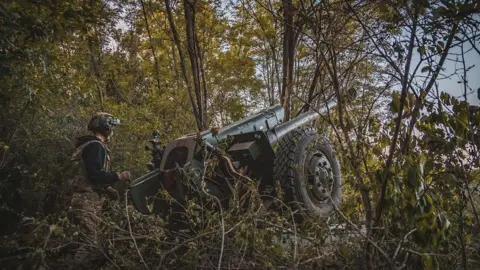
The head of Ukraine’s army, Gen Oleksandr Syrskyi, has said his troops have stopped Russian advances in the northeastern border region of Sumy.
During a visit to the front on Thursday, Syrskyi said the line of combat had been “stabilised” and that the Russian summer offensive in the area had been “choked off”.
However, Syrskyi also added that he had personally gone to check on fortifications in the region and that more were urgently needed.
Syrskyi’s comments on the successes of the Ukrainian troops in Sumy back recent statements by Ukrainian officials that Russia’s pressure on the region was declining.
However, the situation remained “volatile”, Border Guard spokesperson Andriy Demchenko said earlier this week.
Sumy borders the Russian region of Kursk, parts of which were seized and occupied last year by Ukrainian forces in a surprise offensive before being almost totally driven out months later.
The Kursk incursion was an embarrassment for Russia and in April President Vladimir Putin announced a plan to create “security buffer zones” along the border to provide “additional support” to areas in Russia which border Ukraine’s Kharkiv, Sumy and Chernihiv regions.
Moscow has been pushing in the Sumy area with renewed effort since then. In late May Ukraine’s Volodymyr Zelensky said 50,000 of Russia’s “largest, strongest” troops were concentrated along the border and were planning to create a 10km (6-mile) buffer zone.
There has been criticism about the lack of fortifications in some areas of the Sumy region – and in his statement on Thursday Syrskyi tried to quell growing public concerns over delays in their construction.
“Additional fortifications, the establishment of ‘kill zones’, the construction of anti-drone corridors to protect our soldiers and ensure more reliable logistics for our troops are obvious tasks that are being carried out,” he said.
However, Syrskyi acknowledged that these improvements had to be done better and more efficiently.
In the early days of the Russian invasion of Ukraine, the lack of fortifications in certain parts of Ukraine allowed Moscow to make advances across the country – from its northern borders and from the illegally annexed Crimean peninsula.
The window of opportunity to build fortifications in Sumy safely and quickly was in autumn 2024, when Ukrainian troops were still advancing in the Russia’s border Kursk region and Sumy remained relatively unscathed.
Now may be too late, as Russia is undoubtedly well aware of the sections of the front line that lack strong fortifications.
In the last several months Moscow has claimed to have captured several villages while pummelling the city of Sumy with heavy missile strikes, killing dozens. A single ballistic missile attack on 13 April killed at least 34 people and injured 117.
DeepState, a group that monitors the latest frontline developments in Ukraine, has quoted sources as confirming that combat is raging in various unfortified areas of Sumy. The delays with erecting “much-needed fortifications” or the “low quality of some of the dugouts” could no longer be ignored, DeepState analysts said.
Asked about the summer offensive at a forum in St Petersburg last week, Putin said Russia did not “have the goal of capturing Sumy, but I don’t rule it out”. He said Russian forces had already established a buffer zone of 8-12km in depth.
Russia’s full-scale invasion of Ukraine, launched in February 2022, is now well into its fourth year.
Large-scale Russian drone attacks on Ukrainian cities are on the rise. In recent weeks the capital Kyiv was targeted with record numbers of drones that overwhelm air defences and cause deadly explosions.
Recent rounds of talks between Ukraine and Russia resulted in large prisoner exchanges but have so far failed to produce any tangible progress towards a ceasefire.
Earlier this week Nato Secretary General Mark Rutte said that European and Canadian allies had pledged €35bn (£30bn; $41bn) to Ukraine.
But there remains nervousness in Kyiv over the level of US President Donald Trump’s commitment to the Ukrainian cause and his volatile relationship with Zelensky.
However, Trump said on Wednesday a meeting he held with Zelensky on the sidelines of the Nato summit in The Hague “couldn’t have been nicer”.
He told BBC Ukraine’s Myroslava Petsa at a press conference afterwards that he was considering supplying Kyiv with US Patriot air defence missiles to defend itself against Russian strikes.
“We’re going to see if we could make some available. You know, they’re very hard to get,” he said.