
Mazzaltov World News provides you with the latest live coverage of Current Affairs, Sports, Health, Weather, Entertainment, Business and Travel News from around the world.
Here’s where things stand on Thursday 17 July 2025:
- Syria has condemned Israeli strikes on Damascus as a “flagrant assult” aiming to “inflame tensions”
- Israel says it has struck a “military target” in “the area of the presidential palace” in the Syrian capital, as well as a military headquarters in the city
- Three people have been killed by the strikes, Syria’s health ministry says
- Israel says it is trying to protect members of Syria’s Druze community after deadly sectarian clashes – but the strikes have political motive as well as military, says the BBC
- The strikes on Damascus follow days of Israeli attacks on the Suweida region in south-west Syria
- Syrian reports suggest a ceasefire has been agreed in Suweida – but Israel says it’s “increasing the pressure and pace of the strikes” in the area
We want protection of minorities and stability, Israeli FM says
Israeli Foreign Minister Gideon Sa’ar has called the Syrian government’s “independent investigation” into the recurring attacks on minorities in Syria a farce, as he accuses them of taking part in them.
Speaking to various fellow foreign ministers in a series of calls, he told them the attacks on Syria’s Alawite, Kurd, Druze, and Christian minorities are being carried by both the Syrian government and armed groups that support them.
According to a statement from his office, Sa’ar said that the Syrian government made a promise to investigate killings of Alawites earlier this year, which he called hollow.
He told the EU’s Kaja Kallas, Germany’s Johann Wadephul and Greece’s Giorgos Gerapetritis that preventing harm to minorities and respecting their rights were among the conditions set by the EU for lifting sanctions against Syria – and that the continued attacks against them would not allow stability to be achieved.
Sa’ar added that Israel is interested in stability and preventing any threats from rising against it in southern Syria, as well as its commitment to preventing harm to the Druze community.
The government in Syria has been given clear messages and it knows exactly how to restore quiet and stability if it so desires, he told the European ministers.
Syria’s foreign ministry accuses Israel of ‘inflaming tensions’ in ‘flagrant assault’

Syria’s foreign ministry has condemned Israel’s targeting of “government institutions and civilian facilities” in Damascus, as well as in Suweida following today’s aerial attacks.
After Israel’s strikes targeted the ministry of defence building in Damascus, as well as the area around the presidential palace, the foreign ministry says several civilians were killed and dozens more injured.
It says there was also “extensive damage to infrastructure and public services”.
The foreign ministry accuses Israel of carrying out a “flagrant assault” in the pursuit of a “deliberate policy” to “inflame tensions, spread chaos and undermine security and stability in Syria”.
“Syria holds Israel fully responsible for this dangerous escalation and its consequences,” it adds.
Turkey, Lebanon and Iraq condemn Israeli attacks
Here’s a look at some of the regional reaction to today’s attacks.
Israel’s strikes on Damascus and its interventions in the south of the country are “an act of sabotage against Syria’s efforts to secure peace, stability and security”, Turkey says.
“The Syrian people now have a historic opportunity to live in peace and integrate with the world,” the country’s foreign ministry says in a statement.
It adds everyone “committed to seizing this opportunity must contribute to the Syrian administration’s efforts to establish calm”.
Lebanon’s Prime Minister Nawaf Salam also condemns the attacks and has called on the international community to end the violence.
He describes the strikes as “a flagrant violation of Syria’s sovereignty and a breach of the most basic principles of international law”, adding in a statement that Israel’s aggression “cannot be accepted”.
Meanwhile, Iraq’s foreign ministry says it rejects the “endangering” of Syrian lives and intensification of their “humanitarian suffering”.
The statement also reiterates Iraq’s “firm position” in opposing any attacks that violate the sovereignty of any country, warning Israel not to use the fighting in Suweida as a “cover to achieve expansionist goals”.
‘The sky moved’: Damascus man on moment Israeli bombs struck
When the explosions sounded, Faisal was making his way to hospital in the Muhajreen neighbourhood of Damascus for an entirely separate matter.
All morning, he had been feeling pain in his kidney and wanted a doctor’s opinion.
But when the Israeli planes struck, the blasts were so close and so powerful it felt as if someone had hit the inside of his skull.
“My friend said the sky moved,” he tells me. “Our first thought was to hurry up because we know that Israelis could bomb everything and anyone.”
Around him, the streets quickly cleared. Whoever remained was looking up at the sky or down at their phones.
“For several minutes, I forgot my horrible kidney pain,” Faisal says.
UN refugee agency says situation in Syria is ‘very fragile’
Earlier today, I attended a briefing about Syria with the United Nations’ refugee agency, UNHCR, in Washington DC.
It was about the fact that hundreds of thousands of Syrian refugees have returned to the country since the the fall of the Assad regime – something the agency called a “unique, once in a generation” moment.
They are trying to consolidate US and international support to maintain stability and ensure more refugees can safely return.
The officials were asked about Israel’s attacks on Damascus and Suweida, as well as the sectarian violence there.
“It’s a very fragile situation, and what we need for Syria and for Syrians to be able to recover and rebuild is stability. So it certainly doesn’t advance that cause,” said Rema Jamous Inseis, UNHCR’s Regional Director for the Middle East.
She added that the UN Secretary General’s office had already said it was very concerned and called for the violence to stop.
US hopes to see progress on de-escalation in ‘next few hours’, Rubio says
US Secretary of State Marco Rubio says he thinks Israel and Syria are on their way “towards a real de-escalation” following Israel’s air strikes on Damascus.
Speaking to journalists, he says that there has been a “misunderstanding” between them, adding: “In the next few hours, we hope to see some real progress.”
Israel says it continues to strike Syria
We have another statement from the Israel Defence Forces now (IDF), which says it “continues to strike military targets” in southern Syria.
The latest statement says in recent hours the IDF hit “several armoured vehicles loaded with heavy machine guns and weapons” that were on the way to the Suweida area.
“Additionally, firing posts, weapons storage facilities, and additional Syrian regime military targets in southern Syria were struck.”
Israel’s escalation risks making new Syrian government look weak
This is the most serious escalation Israeli forces have conducted against the new Islamist government led by interim President Ahmed al-Sharaa.
It is a message coming from the IDF and Israeli government that they are serious about their position not to let this government approach the south of Syria, where the Druze are concentrated in Suweida city.
The Syrian government is in the early stages of establishing itself. They have a weak army, they have weak security forces. Israel itself, following the fall of Bashar al-Assad in December, for 48 hours attacked over 400 military bases to cripple the power of the country.
The new government has made it clear that they’re not here to make any wars in the region. Its forces have no capacity and no will to fight Israel. However, these violations are not only making Sharaa look weak, but making people on the streets very angry.
There is even a split of views within the Druze community – many of whom don’t want to see Israel defending them, and they don’t want to be affiliated to the Israelis.
So it’s really now back to the politics, back to Sharaa and how he will handle this crisis. We are told he is about to deliver a public speech later, so we’ll have to wait and see what he’s going say.
Druze man in Damascus describes fear and confusion following strike
It was a quiet afternoon in the jewellery boutique where Amin works when the glass shattered and he felt the ground in Damascus shake.
Without stopping to think, Amin – a member of Syria’s Druze community who is using a different name to protect his identity – dived under the counter.
Only a few hundred metres up the road, Israeli warplanes had struck the Syrian ministry of defence building, sending enormous dark clouds spilling over the busy intersection.
“It was a big shock,” Amin tells me. “There were some people in the store but no one was hurt.”
Two hours later, he crept out and took stock of the damage. The Israeli attacks were a close call, and he has no way of knowing if next time around, they’ll strike closer to home.
“I am very, very, very worried.”
Israeli bombing of Damascus ‘is not a victory’ – Syrian information minister
We’ve just received the first official Syrian government response to Israel’s strikes on Damascus.
Information Minister Hamza al-Mustafa says the Israeli attacks are not a victory, but “an escape from the internal pressures” facing its government.
Speaking to Syrian state media, the minister adds that the “people of Suweida Province are a fundamental pillar of the Syrian state, which embraces all its components and they are part of this homeland”.
Strikes begin and then intensify, while reporter is on air
Dramatic footage shows the moment Israel begins striking the headquarters of Syria’s military, as a reporter for Al Jazeera is on air.
Smoke billows from the building behind the reporter, who ducks at the moment of impact.
Wearing a special helmet and vest, identifying him as press, the reporter begins describing to viewers what it is he can see before him. Follow-up footage then shows strikes on the building intensifying until it’s almost entirely covered by smoke.
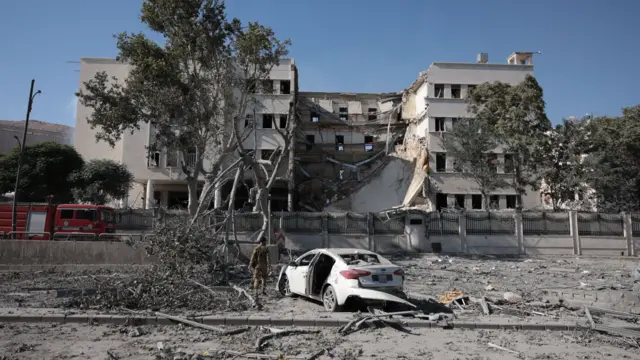
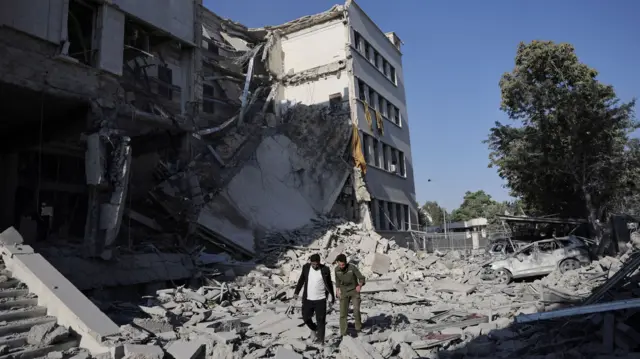
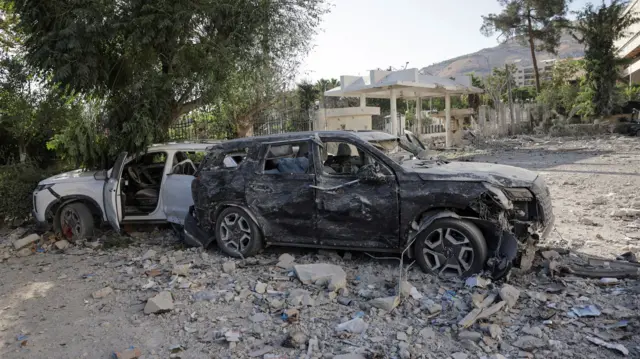
Images show aftermath of Damascus strikespublished at 17:4817:48
We’ve just received more pictures of the damage in Damascus following Israeli strikes, which have killed at least three people and injured another 34.
Druze community’s quest for autonomy source of tension
Since the fall of Bashar al-Assad in December, the Druze community in Suweida has resisted any reassertion of central government authority. While not all Druze factions agree, many rejected the presence of official Syrian military or security forces in their main city, opting instead to govern and protect themselves through local militias.
This desire for autonomy sparked growing tensions with Bedouin groups in the region, many of whom are backed by the new Islamist-led government in Damascus.
What began as a fragile balance quickly unravelled. Clashes erupted on Sunday between Druze fighters and Syrian troops deployed under the pretext of restoring stability. But reports from local sources say those forces committed abuses – killing civilians, looting homes, and humiliating community leaders. A ceasefire brokered yesterday collapsed within hours.
Israel’s intervention has further complicated the landscape. Its strikes appear aimed at deterring Damascus from pushing into Suweida, but they also raise the stakes of a broader sectarian or regional spill over.
For now, the Druze face a difficult reality: their calls for autonomy clash directly with Damascus’s determination to reassert control. With blood already spilled and outside powers now involved, the path forward looks increasingly volatile and uncertain.
Three killed and 34 injured in Damascus – health ministry
Three people have been killed in Israeli strikes on Damascus, the Syrian health ministry reports.
A further 34 have been injured, the ministry adds in its latest update on the impact of the attacks.
What we know so far
If you are just joining our coverage or need a quick recap, let’s bring you up-to-date with the key developments in the last few hours:
- Israel has intensified its airstrikes on Syria, including hitting the defence ministry and area near the presidential palace in the capital Damascus
- Israel says its forces are protecting the minority Druze community – and aiming to eliminate pro-government forces accused of attacking them in Syria’s south-western Suweida region
- It comes after days of deadly clashes between armed Bedouin groups and Druze militia in Suweida
- US envoy Tom Barrack has called on all parties to “step back” from violence which has escalated in recent days
- The UK-based Syrian Observatory for Human Rights (SOHR) monitoring group says more than 300 people have been killed since fighting erupted on Sunday

IDF says it is ‘increasing pressure and pace of strikes’ on Syria
We’ve just heard another update from the Israel Defense Forces, which says its troops are “operating decisively in the Suweida region”.
In a statement, a commander says Israeli forces are “targeting Syrian regime assets in the area” and are “increasing the pressure and pace of the strikes”.
And, after the Syrian defence ministry headquarters was hit by air strikes, the IDF official adds that Israel has “also struck in Damascus and will continue to strike in the southern Syria region”.
As a reminder, earlier reports from Syria indicated a ceasefire had been declared in Suweida – the fourth since Sunday.
Syrian state TV shows strike on military HQ
Footage from Syrian state broadcaster Syria TV shows the moment the country’s military headquarters was hit.
You can watch that video below.
As we reported a little earlier, the Israeli military said it had struck the entrance of the Syrian government’s military headquarters, in the capital Damascus.
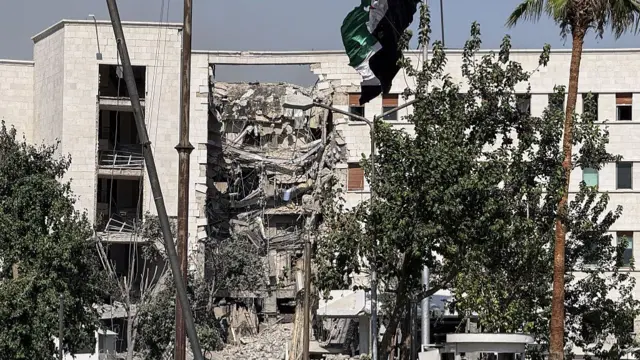
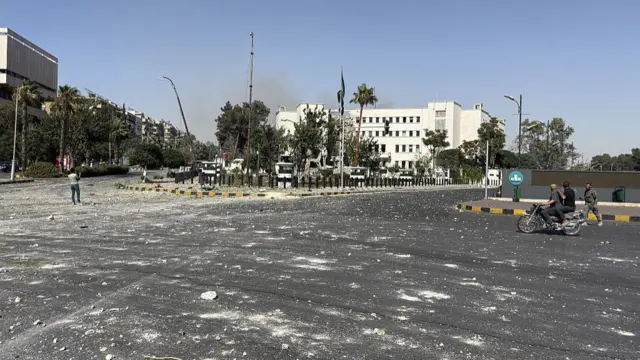
Severe damage to defence ministry building
Pictures are now coming in showing the extent of the damage done to Syria’s defence ministry headquarters.
Traffic has been stopped as security forces work in the area. Debris can be seen strewn in the surrounding roads and the front of the building has been severely damaged.
Number of injured rises to 28 – Syrian health ministry
The number of people injured in Damascus has risen to 28, the Syrian health ministry says in an update on the impact of Israelis strikes.
It had previously reported one person killed and 18 injured.
Reports of new ceasefire in Suweida, as death toll exceeds 300
A ceasefire agreement has been reached in Suweida, Syrian state news agency Sana has reported.
Citing an interior ministry source, the report says security checkpoints have been set up in the city, which Sana says will now be fully integrated into the Syrian state.
This is the fourth such ceasefire declared in Suweida since Sunday, all of which have swiftly broken out into further clashes.
For context, more than 300 people have been killed in southern Syria in recent days, according to the UK-based Syrian Observatory for Human Rights (SOHR) monitoring group.
Since fighting erupted on Sunday in Suweida, SOHR says 69 Druze fighters have been killed as well as 40 civilians.
SOHR says 27 of the Druze were killed in “summary executions” by government forces.
A further 165 Syrian troops and 18 Bedouin fighters have been killed, SOHR reports. It also says 10 members of the security forces have been killed in Israeli strikes.
Israeli strikes have political motive, as well as military
While Israel’s strikes in Syria may appear to be a show of strength, they reflect more than simple muscle-flexing.
Syria’s post-Assad government is still in its infancy – its army and security forces are weak, fragmented, and struggling to assert control.
In the immediate aftermath of former dictator Bashar al-Assad’s fall in December, Israel launched a sweeping wave of air strikes, targeting more than 400 military sites in just 48 hours.
The intent was clear: to prevent any rapid militarisation that could threaten Israeli security, particularly near its northern border.
Although the new Syrian leadership has signalled it has no appetite for regional war – and quiet, US-backed negotiations with Israel may be under way. Israel sees a red line in the presence of what it regards as Islamist-aligned forces near Druze communities and the Israeli buffer zone.
The strikes are as much a deterrent as they are a warning.
But the campaign is not without consequence. It’s stirring anger on the Syrian street and even dividing opinion among Druze, some of whom reject any association with Israel.
Ultimately, these strikes are as political as they are military, aimed at shaping the emerging post-Assad order before it hardens.
Three commanders killed in Israeli strikes on south, Syrian campaign group says
Three Syrian commanders leaders have been killed in Israeli strikes on southern Syria, according to the Syrian Observatory for Human Rights (SOHR) monitor.
The UK-based campaign group – which monitors and releases reports on casualties in Syria – says the strikes specifically targeted military convoys as defence ministry officials gathered.
It says the strikes came down in the countryside around the villages of Walgha and al-Majimar, near the city of Suweida where clashes between armed Druze and Bedouin groups have taken place in recent days.
The SOHR previously reported that seven military officials were killed in previous Israeli strikes in Suweida, including on a tank and military vehicle – bringing the total count to at least 10.
US ‘talking to both sides’ to end Syria fighting, Marco Rubio says

US Secretary of State Marco Rubio says “we’re very concerned” about the Israeli strikes on Syria.
He tells reporters that the US wants the fighting to end and confirms they are “talking to both sides”, adding that hopefully they can stop it.
Rubio adds there will “hopefully” be updates later.
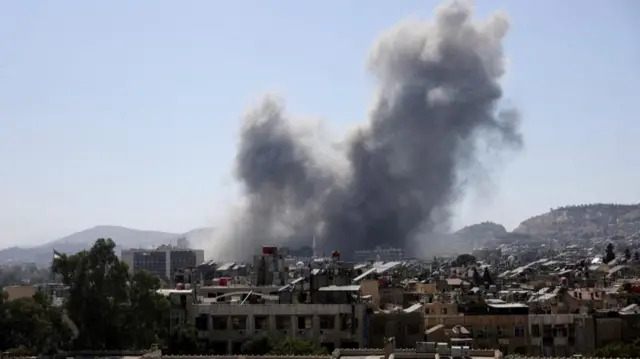
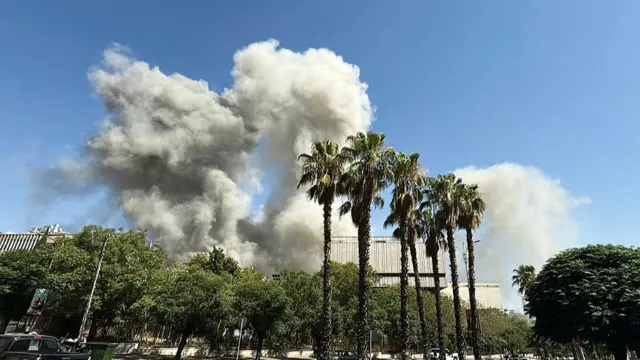
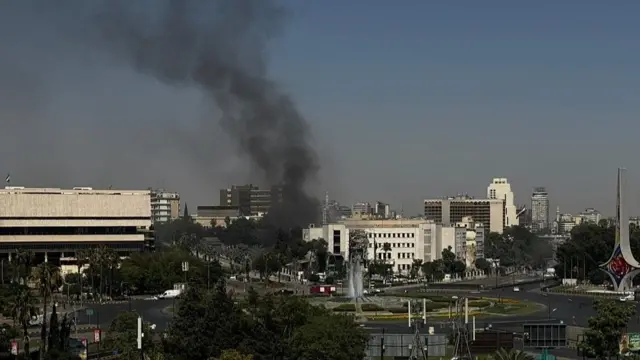
Smoke billows over central Damascus
Large plumes of smoke have been seen rising from central Damascus, after what appears to be hits on the Syrian defence ministry building in Umayyad Square.
It follows powerful Israeli airstrikes that shook the capital earlier.
Strikes on Damascus follow clashes between Druze and Bedouin
Israel’s strikes on Damascus on Wednesday come after armed clashes between Sunni Bedouin fighters and Druze militias in southern Syria began at the weekend.
The violence erupted in the predominantly Druze city of Suweida on Sunday, two days after a Druze merchant was reportedly abducted while travelling by road to Damascus.
On Tuesday, after two days of the deadly clashes, Israel said it had bombed Syrian government forces around Suweida.
Syrian forces have been accused of also attacking the Druze. The government has not responded to then specific allegations, but has condemned the attacks on Druze people and said its troops are there to restore order.
Israel’s prime minister Benjamin Netanyahu said he had ordered strikes on forces and weapons in the area because the government “intended to use [them] against the Druze”. Syria has condemned Israel’s involvement.
At least 200 people have been killed since the clashes started on Sunday,theUK-based monitoring group the Syrian Observatory for Human Rights said on Tuesday.
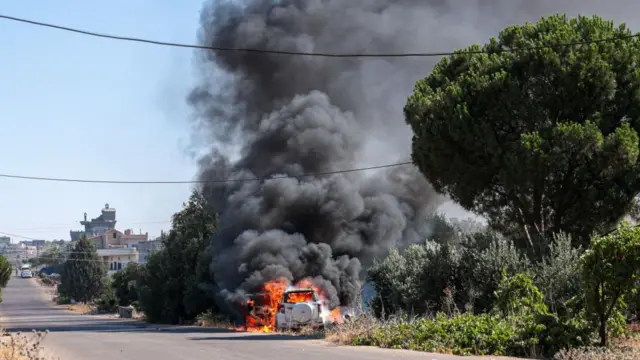
One killed and 18 injured in Damascus, Syria health ministry says
Israeli strikes have killed one civilian and injured 18 more people in Damascus, according to an update from the Syrian health ministry.
IDF confirms it carried out strike near presidential palace
The Israel Defense Forces (IDF) says it targeted the area around Syria’s presidential palace in strikes earlier.
In a post on social media, the IDF says “a military target was struck in the area of the Syrian regime’s Presidential Palace in the Damascus area”.
It also confirmed Syria’s defence ministry headquarters was hit in the attacks on the capital.
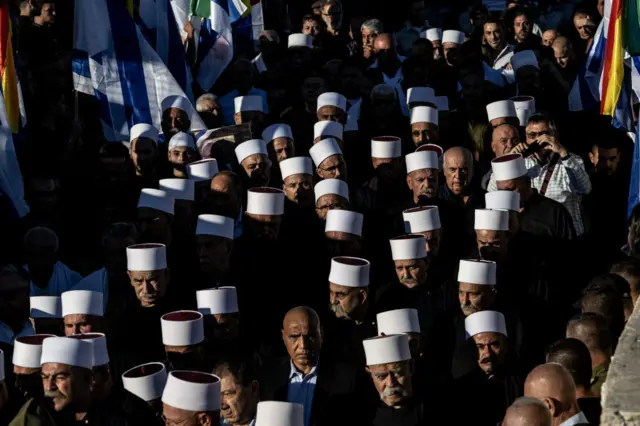
Who are the Druze?published at 15:3215:32
The Druze faith is an offshoot of Shia Islam with its own unique identity and beliefs.
They have historically occupied a precarious position in Syria’s political order. Half its roughly one million followers live in Syria, where they make up about 3% of the population, while there are smaller communities in Lebanon, Israel and the occupied Golan Heights.
Earlier this year, Israeli Prime Minister Benjamin Netanyahu warned he would not “tolerate any threat to the Druze community in southern Syria” from the country’s new security forces.
He also demanded the complete demilitarisation of much of the south, saying Israel saw Syrian president Ahmed al-Sharaa’s Sunni Islamist group, Hayat Tahrir al-Sham (HTS), as a threat.
Nine injured in Damascus strikes – Syrian health ministry
Nine people have been injured as a result of Israeli strikes in Damascus, according to a preliminary assessment just released by the Syrian heath ministry.
Syria condemns Israeli attacks in south as ‘criminal and illegal’
The Syrian government has not yet responded to this round of Israeli strikes, but a few hours ago it condemned what it calls Israel’s “criminal and illegal behaviour” in the south of the country.
In a statement, the Syrian presidency called the ongoing fighting between Druze militias and Bedouin tribes unacceptable under any circumstances and contradictory to their principles.
Israel has recently begun intervening in the conflict, saying it is doing so to protect the minority Druze community from attacks.
The statement added that they will affirm their “full commitment” to investigating all the related incidents and will not allow those responsible to go unpunished.
The government said that it places the highest priority on “protecting security and stability” throughout Syria, and that justice is the standard by which they operate.
It concluded by reassuring the people of Suweida – a predominantly Druze city – that their rights will always be protected and that they will not allow anyone to influence their security or stability.
Smoke rises over Damascus following Israeli strikes
We can see smoke rising above Damascus, following a new round of Israeli strikes on Syria’s capital.
It appears the principal target was Syria’s defence ministry headquarters, as confirmed by an Israeli statement and local media reports.
IDF says it struck Syrian regime’s military HQ
We can now bring you an update from the Israel Defense Forces (IDF), who say its forces have struck the entrance of the Syrian government’s military headquarters in the capital Damascus
In a post shared on X, the IDF says it “continues to monitor developments and the regime’s actions against Druze civilians in southern Syria”.
It goes on to say that on orders from Israeli politicians, the IDF is “striking in the area and remains prepared for various scenarios”.
Israel defence minister: ‘Warnings have ended and painful blows to come’

Shortly after Israeli strikes on Damascus began, Israel’s defence minister shared a statement of intent on social media.
“The warnings in Damascus have ended – now painful blows will come,” Israel Katz writes.
Katz says the Israeli military will “continue to operate forcefully” in Suweida, the area of southern Syria where Israel has recently intervened in clashes between the minority Druze community and other armed groups.
He then speaks directly to the Druze community in Israel, saying the Israel Defense Forces will protect the Syrian Druze population.
“Prime Minister Netanyahu and I, as Minister of Defence, have made a commitment – and we will uphold it,” he adds.
Katz also shared a video of a live TV news broadcast, showing a building in Damascus being hit by a strike and the on-air newsreader ducking for cover.
Israel strikes Damascus as Syrian attacks intensify
Israel has intensified its airstrikes on Syria, including on the capital Damascus, as it says it is intervening in support of the minority Druze community – who are engaged in an ongoing conflict with other Syrian armed groups.
Defence Minister Israel Katz has shared video of a live news broadcast which shows a direct hit on a Damascus building.
We will be bringing you the latest updates from Syria here, stay with us.
