
Mazzaltov World News provides you with the latest live coverage of Current Affairs, Sports, Health, Weather, Entertainment, Business and Travel News from around the world.
Here’s where things stand on Friday 1 August 2025:
- Donald Trump’s Middle East envoy Steve Witkoff has visited Gaza to inspect aid distribution sites backed by the US and Israel
- He was joined by ambassador to Israel Mike Huckabee, who shared images from an aid point run by the controversial Gaza Humanitarian Foundation (GHF)
- It comes as Human Rights Watch accuses Israeli forces and US-backed contractors of putting in place a “flawed” aid distribution system that turns sites into “regular bloodbaths”
- Israel has accused Hamas of instigating the chaos near the aid sites, saying its troops have only fired warning shots and that they do not intentionally shoot civilians
- According to the UN human rights office, at least 1,373 Palestinians have been killed while trying to get food aid since the GHF began operating in late May – the GHF rejects these figures
- The Israeli government does not allow international news organisations into Gaza to report freely
Human rights group accuses Israel of ‘bloodbaths’ at aid sites after US envoy visit
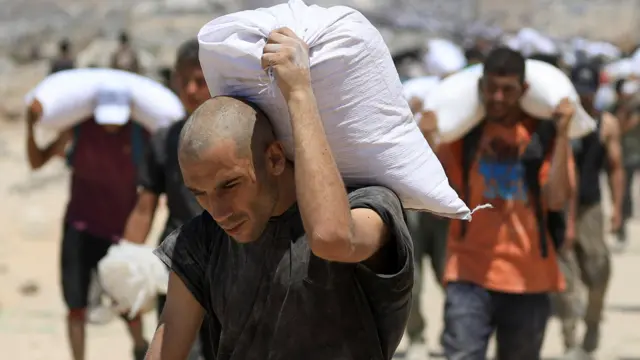
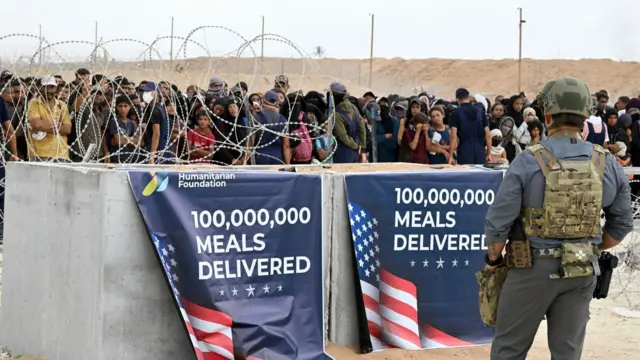
Earlier today, Donald Trump’s Middle East envoy and Israel ambassador visited Gaza, to inspect an aid distribution site run by the controversial US and Israel-backed Gaza Humanitarian Foundation (GHF).
Steve Witkoff and Mike Huckabee were photographed alongside members of the Israeli military at one of the sites thought to be near Rafah, in the south of the territory. One image showed a crowd of Palestinians, stationed on the opposite side of a wall and behind barbed wire, watching on.
The US visit follows reports of near daily shootings of Palestinians at GHF sites. Shortly after they departed, campaign group Human Rights Watch accused Israeli forces and US-backed contractors of establishing “a flawed, militarised aid distribution system that has turned aid distributions into regular bloodbaths”.
The latest figures from the UN say at least 1,373 Palestinians have been killed at aid sites trying to get food since May, with at least 859 of them being killed in vicinity of GHF sites.
Israel says its troops do not intentionally open fire on civilians and accuses Hamas of instigating chaos near the sites. The GHF rejects these figures.
US ambassador shares more photos from GHF site visit
The US Ambassador to Israel Mike Huckabee has shared photos of his and Middle East envoy Steve Witkoff’s visit to Gaza earlier today, where they inspected a Gaza Humanitarian Foundation (GHF) aid site.
“We received briefings from IDF and spoke to folks on the ground,” he says on X, external, to “learn the truth” about the GHF aid sites, which are backed by the US and Israel.
According to the UN human rights office, at least 1,373 Palestinians have been killed while trying to get food aid since the GHF began operating in late May. It said most of them were killed by the Israeli military.
The office said on Thursday that at least 859 of them had been killed in the vicinity of one of the GHF’s four distribution centres, which are operated by US private security contractors and are located inside Israeli military zones.
Another 514 people had been killed along the routes of UN and other aid convoys, it added.
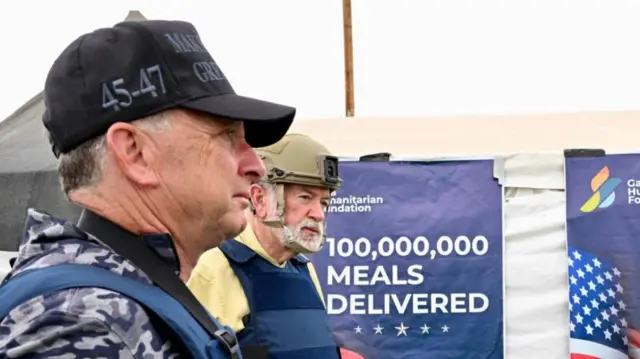

Witkoff visit comes as Israel faces mounting pressure over starvation in Gaza
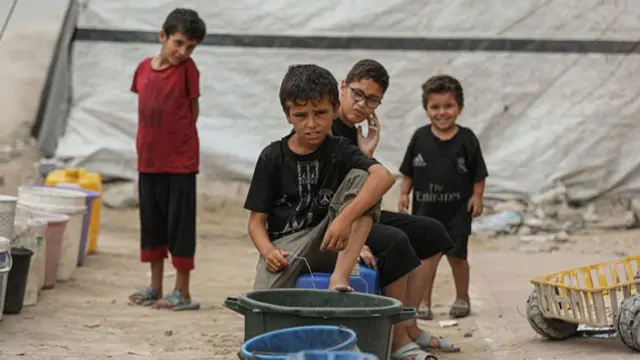
Steve Witkoff’s visit to Israel and Gaza comes as Israel faces growing international isolation over the starvation crisis in the Gaza Strip, with images of emaciated children and accounts of Palestinians starving to death sparking global outrage.
Polls around the world suggest that public opinion is increasingly negative about Israel, which is putting pressure on leaders to act. According to Pew research, external published last month, before the crisis in Gaza worsened, in 20 of 24 countries surveyed, around half of adults or more had an unfavourable view of Israel – including the US.
In recent days, even some MAGA Republicans, the heart of President Trump’s base, have publicly voiced opposition to America’s support for Israel. Representative Marjorie Taylor Greene has described Israel’s actions in Gaza as genocide, an accusation that Israel has always strongly rejected. However, human rights groups, including two leading organisations based in Israel, and a growing number of experts are describing Israel’s actions in Gaza as such.
The UN, aid agencies and even some of Israel’s allies blame its restrictions on the entry and distribution of aid for the hunger crisis in Gaza. Israel has categorically rejected the allegations and has also denied that starvation is happening in the territory, despite mounting evidence.
Israel had blocked the entry of all humanitarian aid into Gaza between March and May, in what was then described by Israeli authorities as a strategy to put pressure on Hamas to agree to a ceasefire and hostage release deal, which did not happen. It was accused of using food as a weapon and a war crime, which it also denied.
Then, Israel created a controversial new system for the distribution of supplies, through the Gaza Humanitarian Foundation (GHF), which requires people to walk to a handful of militarised hubs, often at great risk. It said the system, which largely bypassed the UN and other agencies with decades of experience, was needed to prevent the large-scale diversion of aid by Hamas, although it has never provided evidence of that.
The UN has described the mechanism as insufficient and inhumane, calling it “death traps”: it says more than 1,000 Palestinians have been killed while seeking aid under the system.
Air dropping aid is an act of desperation that won’t end hunger in Gaza

Almost a week has passed since Israel offered to allow air drops of aid into Gaza. It’s a gesture towards allies who are issuing strong statements blaming Israel for starvation in Gaza.
In other wars I have seen aid being dropped, both from the aircraft themselves and close up on the ground as it lands.
It is a crude process, that will not on its own do much to end hunger in Gaza. Only a ceasefire and an unrestricted, long term aid operation can do that.
Air dropping aid is an act of desperation. It can also look good on television, and spread a feel-good factor that something, at last, is being done.
Professionals involved in relief operations regard air dropping aid as a last resort. They use it when any other access is impossible. That’s not the case in Gaza. A short drive north is Ashdod, Israel’s modern container port. A few more hours away is the Jordanian border, which has been used regularly as a supply line for aid for Gaza.
Dropping aid delivers very little. Even big transport planes do not carry as much as a convoy of lorries.
Pallets dropped by parachute often land far from the people who need it. Israel has forced hundreds of thousands of starving Palestinian civilians into a tiny area on the southern coast of Gaza. Most of them live in densely packed tents. It is not clear if there is even an open space for despatchers high in the sky to aim at.
Each pallet will now be fought over by desperate men trying to get food for their families, and by criminal elements who will want to sell it for profit.
What we know about aid airdrops over Gaza
Last week, Israel said it would allow Jordan and the United Arab Emirates to resume airdropping humanitarian supplies into Gaza. The announcement came at a time of growing international pressure on Israel due to the worsening humanitarian situation in the Gaza Strip.
Israeli military body Cogat, which co-ordinates the entry of aid into Gaza, says that since Saturday – and not including today – close to 200 pallets (boxes with a parachute) were dropped into Gaza. Each airdrop weighs dozens of tonnes, it adds.
Since then, Jordan and the UAE have carried out several airdrops.
On Sunday, the UK said it was working with Jordan to drop aid into Gaza and evacuate children needing medical assistance, with military planners deployed for further support.
Earlier this week, Spain said it would be delivering 12 tonnes of food to Gaza.
On Wednesday, the Belgian government said a plane carrying medical supplies and food worth 600,000 euros (£520,254) would fly “soon” to Jordan and remain on standby to carry out airdrops in coordination with Amman.
“These airdrops are a first step, but they can in no way be a cover for the urgent need to facilitate access by land,” Belgian foreign minister Maxime Prevot said.
Today, the German government announced that it would deliver 14 tonnes of food and medical aid to Gaza.
Unrwa boss calls airdrops ‘insufficient and inefficient’

The UN’s agency for Palestinian refugees says airdrops are more costly than trucks, and carry less aid.
Unrwa chief Philippe Lazzarini says that if there is political willingness to conduct airdrops – which he says are “highly costly, insufficient and inefficient”- then there should be “similar… to open the road crossings”.
Lazzarini says Gazans are “starving to death,” adding: “The only way to respond to the famine is to flood Gaza with assistance”.
In a post on X, he says Unrwa has 6,000 trucks loaded with aid stuck outside Gaza, as they await “the green light to enter”.
The UN official recalls that Unrwa and other organisations were bringing somewhere between 500 and 600 trucks a day into Gaza during the ceasefire earlier this year, when “aid reached the entire population of Gaza in safety and dignity”.
Human Rights Watch accuses Israel of ‘regular bloodbaths’ at aid points
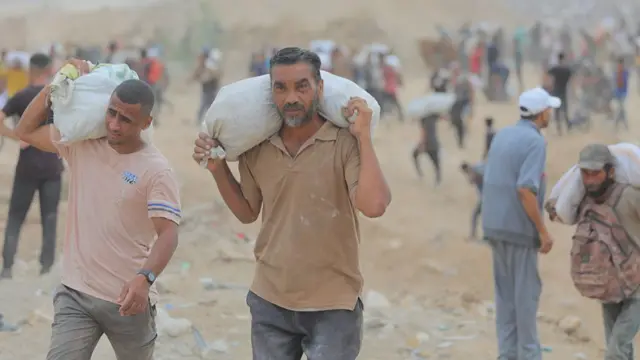
The campaign group Human Rights Watch (HRW) has accused Israeli forces and US-backed private contractors of putting in place “a flawed, militarised aid distribution system that has turned aid distributions into regular bloodbaths”.
The mechanism to which they are referring is run by the US and Israel-backed Gaza Humanitarian Foundation (GHF), which replaced the UN distribution mechanism in May.
Since, there have been near daily reports of shootings near the sites. Israel says its troops have only fired warning shots and that they do not intentionally shoot civilians, blaming Hamas for instigating chaos near the aid sites.
In a lengthy statement, Human Rights Watch says the dire humanitarian conditions in Gaza are a “direct result of Israel’s use of starvation of civilians as a weapon of war” and its “continued intentional deprivation of aid and basic services”.
HRW’s Belkis Wille adds: “Israeli forces are not only deliberately starving Palestinian civilians, but they are now gunning them down almost every day as they desperately seek food for their families.”
The group argues that nations should put pressure on Israel to “immediately stop using lethal force as crowd control against Palestinian civilians” and calls for GHF mechanism to be suspended.
Israel has insisted there are no restrictions on aid deliveries and that there is “no starvation” in Gaza.
US ambassador shares images from Gaza aid point visit
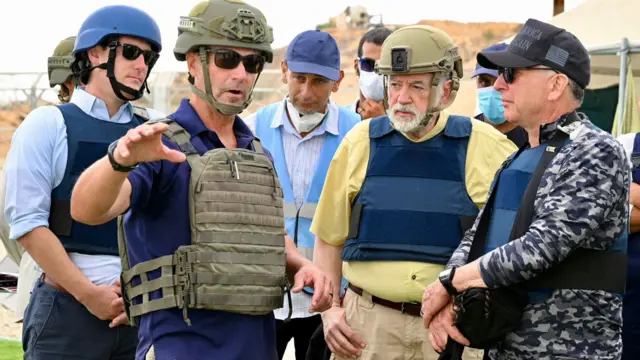
In the last few moments the US Ambassador to Israel Mike Huckabee has posted images after a visit to an aid point in Gaza today.
In a post on X, Huckabee says: “Went into Gaza today and observed humanitarian food program by US launched GHF.
“Hamas hates GHF [Gaza Humanitarian Foundation] because it gets food to people without it being looted by Hamas.
“Over 100 MILLION meals served in 2 months.”
The White House previously said Huckabee would be joining Steve Witkoff for the visit.
- For context: The aid sites they visited are those run by the US and Israel-backed Gaza Humanitarian Foundation (GHF), which replaced the UN distribution mechanism in May. Since then, aid groups have expressed alarm at the near daily reports of Palestinians being killed near the GHF’s sites, which are inside Israeli military zones. Israel says its troops have only fired warning shots and that they do not intentionally shoot civilians
The latest developments
- President Donald Trump’s special envoy Steve Witkoff arrived in Gaza a few hours ago to inspect controversial aid distribution sites backed by Israel and the US.
- It follows near daily reports of shootings at the Gaza Humanitarian Foundation (GHF) points
- Latest figures from the UN say 1,373 Palestinians have been killed seeking food since late May, with the majority shot dead near distribution facilities
- Gazans have denounced Witkoff’s visit. One Palestinian tells our Gaza correspondent Rushdi Abualouf: “This visit is a hollow media stunt not a humanitarian mission”
- It comes amid warnings of famine from aid agencies and mounting reports of hunger-related deaths in Gaza
- Meanwhile, at least 10 people have been killed in southern and central Gaza since dawn on Friday, Hamas-run civil defence says.
Ten killed in southern and central Gaza, says Hamas-run civil defence
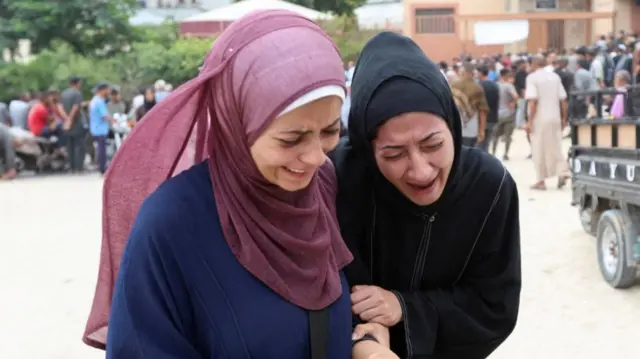
At least 10 Palestinians have been killed in southern and central Gaza since dawn on Friday, according to a spokesperson for the Hamas-run civil defence.
The spokesperson tells the BBC that eight people were killed in two separate Israeli air strikes that targeted tents sheltering displaced families, one in Khan Younis in the south, and the other in Deir al-Balah in the central Gaza Strip.
Separately, two more people were killed and at least 20 others injured when Israeli forces opened fire near an aid distribution point along the Morag corridor north of Rafah, the spokesperson adds.
Local residents said hundreds of people had gathered to get food when the shooting began.